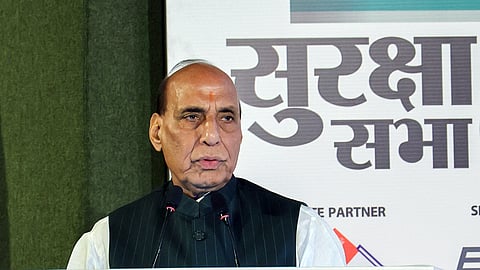

Defence Minister Rajnath Singh on Monday said the armed forces have been given the “freedom and resources” to respond decisively to threats, including the ability to strike adversaries inside their own territory.
Addressing an event, Singh said India believes in peace and does not seek war or the occupation of another country’s territory. But, he added, peace should not be confused with weakness.
“Peace born of the fear of war is to be condemned, while war fought for the sake of peace is worthy of reverence,” he said.
Singh said the government had made it clear that countries promoting terrorism against India would face a military response rather than dialogue. “We've made it clear that if any country promotes terrorism against India, there will be no dialogue; instead, our defence forces will deliver a befitting response,” he said.
The Defence Minister said India was pursuing strategic autonomy and independent decision-making amid geopolitical uncertainties. He accused adversaries of attempting to undermine the country’s security by misleading youth in Jammu and Kashmir, funding anti-India activities, spreading violence and terrorism, and creating divisions within society.
The government, he said, had countered these efforts through rehabilitation and de-radicalisation programmes, efforts to bring misguided youth into the mainstream, and the creation of employment and business opportunities.
Singh said Jammu and Kashmir had witnessed “unprecedented progress” since the abrogation of Article 370, with new opportunities opening up for the youth.
He cited surgical strikes, the Balakot airstrike and Operation Sindoor as examples of India’s strategy of dealing with terrorism through decisive military action targeting terrorists and their handlers.
“The suspension of the Indus Waters Treaty sent a clear message that blood and water cannot flow together,” he said.
Referring to attempts to create social discord, Singh said such efforts had been thwarted by the unity of Indians. He also referred to attacks on places of worship during Operation Sindoor, saying people had rejected attempts to divide society.
On the changing nature of warfare, Singh said space and cyberspace had emerged as new domains of conflict alongside land, air and sea. Artificial intelligence, drones, autonomous systems and precision weapons, he said, were transforming the battlefield.
The government was working to make India’s defence strategy and security apparatus “future-ready”, with a focus on developing advanced technologies domestically, he said.
Singh said India’s defence policy had moved “beyond reactive to being pro-active”. He credited Prime Minister Narendra Modi’s diplomacy and leadership for India’s entry into the Missile Technology Control Regime in 2016, which, he said, facilitated efforts to extend the range of the BrahMos missile.
On the transformation of the defence sector, Singh said the government had focused on strengthening border security, modernising the armed forces, increasing indigenous production and revamping ordnance factories.
These measures, he said, had made India more self-reliant in defence. Defence production, which stood at around Rs 40,000 crore before 2014, has risen to approximately Rs 1.80 lakh crore, while defence exports have grown 56-fold to over Rs 38,000 crore, he said.
Singh said India had moved from an import-dependent model towards indigenous defence manufacturing under the Aatmanirbharta initiative.
He listed systems and platforms including the Akashteer air defence control system, Akash missile, Pinaka rocket launcher, Astra air-to-air missile, Prachand and Dhruv helicopters, Tejas fighter aircraft, Arjun tank and indigenous drone and counter-drone systems.
India’s first indigenous aircraft carrier, INS Vikrant, has also been inducted into the Navy, he said, adding that the country was now developing a range of advanced defence systems, including sixth-generation fighter aircraft.
“Our aim is to export defence equipment worth Rs 50,000 crore by 2029,” Singh said.
He said the government’s objective was to achieve Aatmanirbharta in defence while building an ecosystem that strengthens national security, drives economic growth and expands India’s role in the global security architecture.
Singh expressed confidence that by 2047, India would not only become a Viksit Bharat but also emerge as a global leader in technology, the economy and defence.
(With inputs from PTI)
