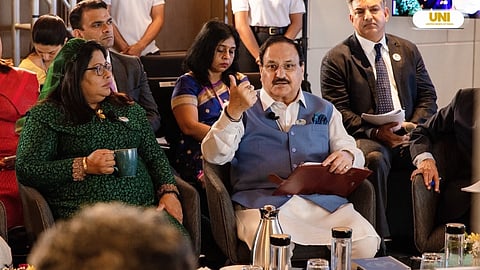

NEW DELHI: Union Health and Family Welfare Minister JP Nadda on Tuesday said equitable access to specialised care is integral to achieving Universal Health Coverage (UHC) and requires a comprehensive approach encompassing education and training, deployment, retention and continuing professional development of the healthcare workforce.
“India's approach is moving towards building a larger, more diverse and geographically well-distributed health workforce, with sustained emphasis on underserved areas and shortage specialities,” Nadda said at a ministerial roundtable on Human Resources for Health: Equity in Specialized Care, held during the 79th Session of the WHO Regional Committee for South-East Asia (RC79) in Timor-Leste.
In his address, the minister highlighted India's significant progress in expanding its health workforce capacity and strengthening access to specialised healthcare, particularly for people living in rural, tribal, underserved and hard-to-reach areas.
He said the government has significantly expanded medical education infrastructure through the establishment of new medical colleges and the upgradation of existing government medical colleges, resulting in a substantial increase in undergraduate and postgraduate medical seats.
Since 2014, the number of medical colleges in the country has more than doubled, from 387 to 858, registering an increase of 121.71 per cent.
During the same period, MBBS seats have increased from 51,348 to 1,42,464, an increase of 177.45 per cent, while postgraduate seats have risen from 31,185 to 86,287, an increase of 176.69 per cent.
Highlighting the targeted expansion of postgraduate capacity, Nadda said schemes for increasing medical seats were extended in September 2025, with a target of creating 10,000 additional postgraduate seats by 2028-29. Priority has been accorded to underserved areas and shortage specialities such as emergency medicine, geriatrics, psychiatry and family medicine.
Stressing the importance of a strong and diversified healthcare workforce, he said 157 new nursing colleges are being established alongside existing medical colleges.
“These institutions are expected to add approximately 15,700 nursing graduates annually, with particular emphasis on improving access to quality and affordable nursing education in underserved districts and states/Union Territories,” he added.
He further noted that nurse practitioner programmes have been introduced in 10 critical specialities, supported by the National Nursing and Midwifery Commission Act, 2023.
On India's efforts to expand the allied and healthcare workforce, Nadda said the government has announced the creation of one lakh allied and healthcare professionals over five years, supported by the National Commission for Allied and Healthcare Professions Act, 2021, and the establishment of the National Commission in 2024.
The Commission brings 57 diverse allied and healthcare professions under a structured regulatory framework.
Nadda highlighted the role of Ayushman Arogya Mandirs in providing comprehensive primary healthcare, including screening, early identification and referral services.
Ayushman Arogya Shivirs further extend screening and specialist consultations to underserved communities, he said.
He also highlighted the role of Community Health Centres and First Referral Units in providing specialist and referral services.
“To improve the availability and retention of specialists in difficult areas, India is adopting flexible mechanisms including competitive remuneration, difficult-area allowances, in-sourcing of speciality services, performance-based incentives and fixed-tenure postings,” he said.
The minister also emphasised that India is leveraging digital health technologies to overcome geographical barriers and extend access to specialist services.
Platforms such as eSanjeevani and ABHA-enabled digital health records are facilitating teleconsultations, referrals and continuity of care, particularly for populations in remote and underserved areas.
“These measures reflect a team-based and continuum-of-care approach to advancing equity in specialized care,” he said.
A key outcome of RC79 was the adoption of the “Dili Declaration on Human Resources for Health: Equity in Specialized Care” by the health ministers of member states of the WHO South-East Asia Region.
Through the declaration, the 11 member states have committed to a comprehensive set of actions aimed at addressing health workforce shortages, maldistribution and the growing need for specialised healthcare.
The declaration calls for aligning health workforce planning, education and financing with current and future demographic, epidemiological and health emergency preparedness needs.
It also calls for policies to attract, recruit, deploy, retain and improve the performance of specialist health workers, particularly in rural and underserved areas, guided by the WHO Global Code of Practice on the International Recruitment of Health Personnel.
The declaration further emphasises optimising the existing workforce through task-sharing, mentoring, rotational outreach and visiting specialist programmes, including collaboration with qualified and registered traditional, complementary and integrated medicine practitioners.
Member states have also committed to strengthening integrated referral systems and continuity of care through primary healthcare teams, specialist outreach services, teleconsultation networks and coordinated referral hospitals.
The declaration calls for strengthening public health workforce capacity and essential public health functions, while accelerating the safe and equitable adoption of digital health technologies, including telemedicine, teleconsultation and AI-supported clinical tools, to expand access to specialist services for rural, remote and underserved populations.
It further promotes innovative service delivery models, including mobile and outreach specialist teams and community-based specialist care, with the integration of traditional, complementary and integrated medicine services.
The member states also agreed to integrate palliative care into health systems at all levels through workforce development, multidisciplinary teams, community-based services and strengthened referral pathways.
The declaration emphasises strengthening national capacity for high-priority specialised services, including cancer, cardiovascular care, trauma, maternal and newborn care, mental health, geriatric care and rehabilitative care. It also calls for strengthening national health workforce information systems to support evidence-based policymaking.
Recognising the importance of regional cooperation, member states committed to facilitating information exchange, joint training, clinical mentorship and regional collaboration, including through a regional network of health professional regulators and policymakers.
The Dili Declaration recalls the commitments made under the 2023 Delhi Declaration on strengthening primary healthcare and responds to the region's rapid demographic and epidemiological transition, rising burden of complex and chronic conditions, and persistent shortages and maldistribution of specialist health workers.
Member states called upon the World Health Organization (WHO) to support the implementation of the commitments through technical assistance, capacity-building, policy guidance and strengthened regional collaboration mechanisms.
India welcomed the adoption of the Dili Declaration as a significant step towards ensuring equitable access to specialised care, advancing Universal Health Coverage and realising Health for All across the South-East Asia Region.
India reaffirmed its commitment to working closely with member states and the WHO to translate the commitments of the declaration into concrete action.
