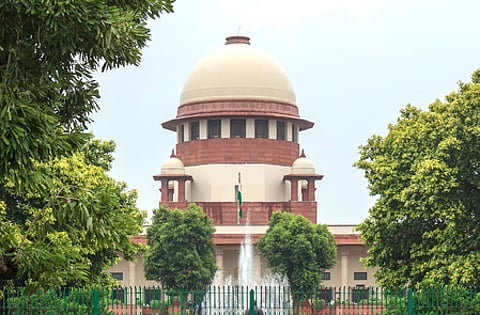

NEW DELHI: In a development with far-reaching implications for Assam's citizenship determination regime, the Supreme Court on Tuesday directed the Centre to bring on record the relevant notifications, constituting orders and notices pursuant to which FT (Foreigners Tribunals) references came to be registered.
A two-judge bench of the top court, headed by Justice Vikram Nath, was hearing a batch of approximately 117 matters arising from FT proceedings in Assam, where a significant issue has emerged — whether the Tribunals that declared persons as foreigners were duly constituted under law.
During the hearing on Tuesday, the top Court sought clarity on the precise notifications, orders or other instruments by which the concerned FTs were constituted and vested with authority to entertain references.
While the parent statutory framework governing foreigners and FTs exists, it was pointed out by the petitioners that no specific notification or constituting order concerning the respective Tribunals in these cases has been placed on record. The State of Assam has also, at this stage, not placed material clarifying the precise legal and administrative instruments under which the concerned Tribunals were constituted, the petitioner contended before the court.
The issue assumes significance because FT proceedings may ultimately result in a determination concerning a person's status as an Indian citizen or foreigner, carrying serious civil consequences, including detention and deportation.
Chander Uday Singh, Senior Advocate, assisted by Adeel Ahmed, Advocate-on-Record (AOR), appearing for the petitioners, submitted that the existence of an enabling statutory framework by itself does not answer the question of whether particular Tribunals exercising jurisdiction were duly constituted in accordance with the procedure prescribed by law.
The top court has consequently directed that relevant notifications, constituting orders and notices pursuant to which FT references came to be registered and proceeded with be brought on record. Nodal Counsel have been asked to coordinate and place relevant material before the Court.
Menaka Guruswamy, Senior Advocate, and Sanjay Hegde, Senior Advocate, were also present in connection with the case.
The proceedings raised an important institutional question: whether the existence of parent legislation and a general statutory framework is sufficient, or whether the State must also demonstrate through relevant notification, lawful establishment and jurisdiction of each Tribunal.
The Supreme Court has not returned a final finding that FTs are invalidly constituted. The issue is under examination, and the State is being required to place foundational material. Submissions remain sub judice.
