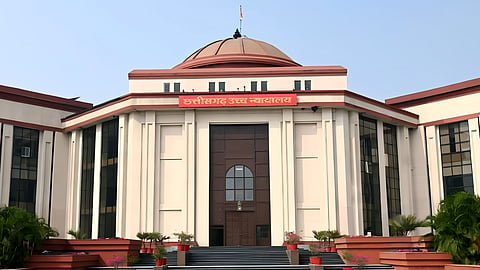

RAIPUR: The Chhattisgarh High Court has ruled that religious bodies like 'Sharia courts' or Dar-ul-Qaza possess no legal authority or status to grant a divorce.
Delivering the judgment in a writ petition filed by a Raipur-based Muslim woman, Justice Amitendra Kishore Prasad declared that any "verdict," "order," or fatwa issued by extra-judicial religious forums is at best a non-binding opinion and cannot be enforced through coercive process or treated as a substitute for a decree passed by a court of law.
The petitioner, Nirosh Abbasi, had challenged a communication-cum-order dated January 18, 2022, issued by the Idara-E-Shariya Islami Court in Raipur.
The document purportedly declared that her marriage to her second husband, Mohd. Abid Khan, had ended through divorce.
Prior to this order, Abbasi had already initiated legal proceedings, lodging an FIR under Section 498-A (cruelty by husband or relatives) and Section 34 of the Indian Penal Code at the women police station, Raipur, citing alleged domestic harassment.
Despite the pendency of statutory legal proceedings, the Idara-E-Shariya issued an order declaring that a divorce had taken place.
Aggrieved by this extra-judicial determination, Abbasi approached the High Court seeking to quash the order and challenge the legitimacy of such parallel judicial establishments.
Appearing for the State of Chhattisgarh, the additional advocate general argued that the Indian constitution does not recognise any parallel religious judiciary.
The husband said that he had independently pronounced Talaq-e-Hasan over three distinct intervals in 2021 due to domestic discord and argued that the religious body's letter was merely a communication of that fact.
The Islami court said in its reply that it was only an advisory and religious body operating under Article 25 of the Constitution, providing non-binding opinions based on the Shariat and the Quran.
Justice Prasad observed that bodies like Idara-E-Shariya or Dar-ul-Qaza have no legal pedigree in India's constitutional order. The high court made it clear that such informal platforms cannot assume the role of statutory family courts or pass orders altering civil or marital rights.
The high court declared the Idara-E-Shariya’s order dated January 18, 2022, to be null, devoid of legal effect, and incapable of altering the petitioner's marital status.
"Religion may guide an individual's conscience and personal faith, but no religious institution or private body can be permitted to assume the authority of a court established by law or to use religious belief as a means of determining or enforcing the legal status and rights of an individual,” Justice Prasad said.
