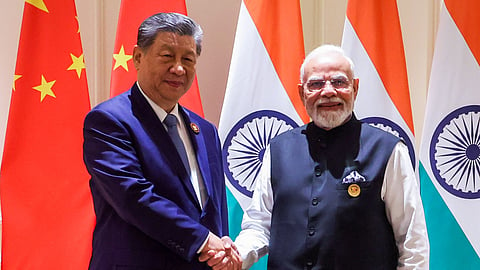

NEW DELHI: Prime Minister Narendra Modi and Chinese President Xi Jinping on Saturday sought to put the cautious thaw in India-China ties on a steadier footing, stressing the need to prevent differences from becoming disputes and to preserve peace and tranquillity along the border. But the border remains a critical test of the normalisation process.
Modi emphasised that peace and tranquillity in the border areas remain an "essential basis" for the continued development of bilateral relations.
"The Prime Minister emphasised that peace and tranquillity in the border areas remain an essential basis for the continued development of bilateral relations. He underlined the need for both sides to observe existing agreements and understandings on border-related issues," the External Affairs Ministry said in a statement.
Xi said China sees India as a “cooperation partner rather than a rival” and that the development of one country should be viewed as an opportunity rather than a threat for the other. Describing the recent improvement in ties as a shift from a “new start” to a “new elevation”, Xi said, “This situation has not come easily and is worth cherishing,” according to a Chinese readout quoted by Chinese state media.
The two leaders met on the sidelines of the BRICS Summit in New Delhi, nearly a year after their previous meeting in Tianjin in August 2025. Their latest engagement comes as institutional exchanges between the two countries resume, economic ties gather momentum and both sides seek to rebuild trust.
The two leaders reaffirmed their commitment to pursuing a “fair, reasonable, and mutually acceptable” resolution to the boundary question, while placing it within the broader political relationship and the long-term interests of both countries.
Modi said the relationship should be guided by three principles — “mutual respect, mutual sensitivity and mutual interest” — while reiterating that “differences should not become disputes”.
Xi laid out a four-point framework for sustaining the improvement in ties. He called for a more objective and rational strategic assessment of the relationship, greater win-win economic cooperation, political wisdom in managing differences and stronger coordination on regional and global issues.
He also called for expanded people-to-people exchanges, greater mobility and the resumption of direct flights, while urging both sides to address economic and trade concerns in a balanced manner.
The two sides acknowledged the need to address concerns including the structural trade imbalance, supply-chain issues and the need for “meaningful and predictable market access”.
According to the Chinese readout, Modi also said that the development of India-China relations “is not influenced by any third party”.
The two leaders also agreed to deepen coordination through BRICS, the United Nations, the Shanghai Cooperation Organisation and the G20, while working together on wider global challenges.
With China set to take over the BRICS chairmanship next year, Modi thanked Beijing for supporting India’s presidency and pledged New Delhi’s support for China’s tenure.
