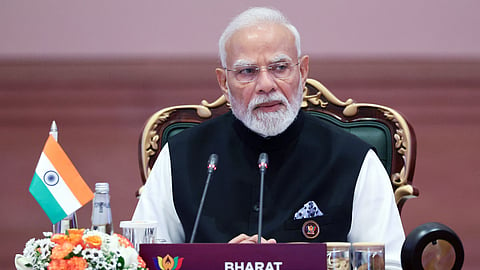

NEW DELHI: Prime Minister Narendra Modi has called for a major overhaul of global governance, asserting that reform of the United Nations Security Council “cannot be delayed any longer” and urging BRICS countries to help transform the Global South from a rule-taker into a “rule-shaper.”
Addressing the BRICS Summit, Modi said the grouping was not directed against any country or bloc, but should instead use its growing influence to build a more representative and inclusive international order.
"We do not go against anyone, but try to move forward with the thought of taking everyone along,” Modi said. He added that BRICS must now convert its unity and consensus into “strong results” on the global stage as it enters its next phase.
Modi described the grouping as being at a moment of “coming of age”, arguing that its next two decades should be guided by a more ambitious agenda.
"Now is the time to transform our unity and consensus on the global stage into strong results. For the next 20 years, we will have to work on a new and ambitious agenda," he said.
Modi proposed a 10-point roadmap for global governance reform, built around three broad priorities: representation, responsiveness and rule-making. He also called for stronger institutional continuity within BRICS, proposing a “BRICS Continuity and Implementation Mechanism” through which the rotating presidency could be supported by systematic follow-up.
“Under this, through the Troika, all initiatives and outcomes can be followed up,” he said, suggesting a secure digital repository recording decisions, nodal points, deadlines and implementation status.
On representation, Modi said the structure of global institutions no longer reflected contemporary economic realities. “The reform in the Security Council cannot be delayed any longer,” he said, calling for timely and clear negotiations.
He also argued that voting rights, leadership positions and policy priorities in international financial institutions should better reflect the contribution of emerging economies to global growth.
On responsiveness, Modi proposed stronger mechanisms to address crises, including a Seafarers Emergency Support Network linking maritime authorities and diplomatic missions to provide distress assistance, medical support, family communication and evacuation during emergencies.
The third pillar, rule-making, focused on emerging technologies. Modi identified artificial intelligence, cyberspace, outer space, biotechnology and other critical technologies as areas where the Global South must have a greater role in setting international norms.
“We have to try to make the Global South a rule-shaper,” he said, proposing negotiation training, legal expertise and practical capacity-building for young diplomats. India, Modi said, was prepared to lead efforts on South-South cooperation.
“If our future is shared, the right to build it should also be shared,” he said, framing BRICS’ next phase as a shift “from voice to impact, from privilege to partnership.”
