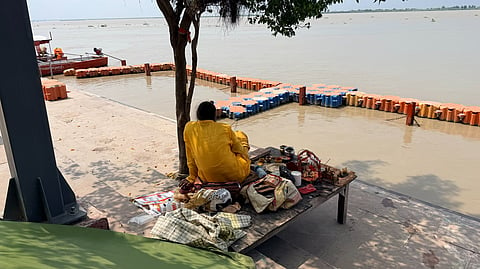

AYODHYA: The Saryu River is in a restless mood. Swollen waters press against the steps of Guptar Ghat, running high after relentless monsoon rains upstream and the release of hundreds of thousands of cusecs from Nepal’s barrages. Yet the river remains within its banks, surging past Ayodhya’s stone steps and ghats.
Guptar Ghat is revered in Hindu tradition as the place where Lord Ram entered the Saryu for his Jal Samadhi. Just a few kilometres away, the Ram Janmabhoomi temple draws an extraordinary stream of pilgrims. But at the ghat, the pilgrimage boom is being counted differently.
Photographer Kapil Yadav, who has worked here for three years, says he now takes around 100 photographs a day, compared with 200-300 earlier. At Rs 10 a photograph, the difference directly affects his earnings.
“The recent controversy has left many disheartened and could be the reason for low footfall,” he said without directly mentioning the alleged irregularities in handling the offerings at the Ram Temple. The official picture, however, is very different.
Ayodhya District Magistrate Shashank Tripathi told TNIE there has been no fall in pilgrim footfall. “According to daily figures available with the administration, footfall is 10-20% higher than last year. There has also been no dip in donations,” Tripathi added.
Vandana Pandey, recently appointed Ram Janmabhoomi Temple Magistrate, also says the rush remains unchanged, with the current lull largely due to the heat. During Ram Navami and Diwali, she says, there is “practically no space to stand”. Devotion, she adds, has shown no decline.
Yet, the view from Guptar Ghat is more nuanced. Juice vendor Dashrath Nishad, who has worked here for seven to eight years, says better facilities at visitor sites could encourage pilgrims to spend more time beyond the temple.
“Whatever money comes should be utilised properly. Improve the places people come to, provide drinking water, seating and good lighting. If the facilities are better, more people will come, and people like us will also benefit,” he says.
Khursheed Alam, a lifelong Ayodhya resident doing municipal work, earns about Rs 11,000 a month. “The city is changing. But this should bring more work for people like us,” he says. That is where the competing pictures of Ayodhya meet. The administration counts pilgrims and the temple counts devotion.
