
CHANDIGARH: Himachal Pradesh, Haryana, Delhi, Rajasthan, Uttar Pradesh and Uttarakhand signed a Memorandum of Understanding (MoU) with the Centre for the Rs 15,624-crore Kishau Dam project on Tuesday.
The 660 MW Kishau Dam project on the Tons river, a tributary of the Yamuna along the Himachal Pradesh-Uttarakhand border, has cleared a major hurdle with the MoU after being stalled for eight years over inter-state coordination.
The long-pending multipurpose project is expected to provide irrigation, electricity, drinking and industrial water and help rejuvenate the Yamuna. The project will now be placed before the Union Cabinet for approval.
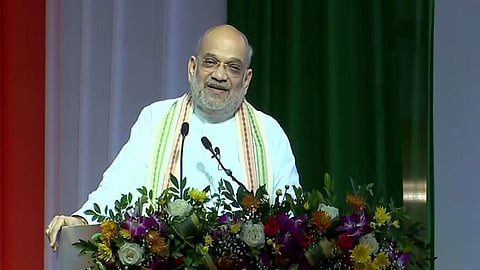
The MoU was signed in New Delhi in the presence of Union Home Minister Amit Shah. It was signed by Union Jal Shakti Minister CR Patil, Himachal Pradesh Chief Minister Sukhvinder Singh Sukhu, Haryana Chief Minister Nayab Singh Saini, Uttarakhand Chief Minister Pushkar Singh Dhami, Uttar Pradesh Chief Minister Yogi Adityanath, Delhi Chief Minister Rekha Gupta and Rajasthan Chief Minister Bhajan Lal Sharma.
The project is being implemented by Kishau Corporation Limited, a joint venture between the governments of Himachal Pradesh and Uttarakhand. The Centre recently assured Himachal Pradesh that it would not have to bear any financial burden for the project. The Centre will bear 90 per cent of the cost of its water component.
Speaking to the media, Sukhu said that at a high-level meeting chaired by Shah on June 16, the Centre had agreed in principle that the estimated Rs 2,000-crore cost of Himachal Pradesh's power component would be borne by the beneficiary states (Delhi, Rajasthan and Haryana) of the water component.
Sukhu said the state government had strongly pursued the issue to protect Himachal Pradesh from the financial burden, which the previous government had not been able to resolve. He said the previous government had agreed to contribute Rs 800 crore, but the present government rejected the proposal in view of the state's limited resources.
He said the state had also argued that a similar assistance to the '90 per cent grant for the water component' should be provided for the power component.
The Himachal Pradesh CM said people in the project area would be displaced and Himachal Pradesh would therefore suffer the maximum loss. He said it was unfair for the state to bear an additional financial burden and that its contribution to the nation's progress should be suitably compensated.
Sukhu said the state will receive 1,000 million units of electricity a year from the project. This is expected to be worth more than Rs 1,000 crore annually after the project is completed.
The project dates back to the Upper Yamuna Basin Water-Sharing Agreement signed by the basin states on May 12, 1994. The agreement provided for sharing the utilisable surface water of the Yamuna up to the Okhla Barrage and recognised the need for storage projects in the basin. It also provided for separate agreements for individual storage projects within the broader water-sharing framework.
The Kishau project will have a 232.6-metre-high concrete gravity dam and a reservoir with a live storage capacity of 1,562 million cubic metres (MCM).
The stored water is expected to provide irrigation benefits to nealry a lakh hectares of agricultural land. It will also augment drinking and industrial water supplies, with Delhi and Rajasthan among the key beneficiaries. The project is expected to strengthen Delhi's long-term water security and provide additional water for drinking and industrial needs in Rajasthan.
The project is also expected to help rejuvenate the Yamuna by increasing the river's flow.
The dam is expected to generate around 1,476 million units of electricity every year. The financing arrangement is among the key decisions reached through the agreement.
