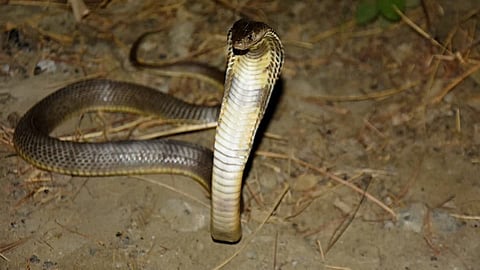

CHANDIGARH: The two people in Himachal Pradesh’s Chamba district who died from Caspian cobra bites in 2020 and 2021, were the first reported deaths in India caused by the venomous Central Asian snake, said a research paper.
The deaths were documented while researchers were collecting data under Indian Council of Medical Research-funded snakebite projects.
The research paper was prepared in July this year and submitted to the journal. It was accepted on August 18 and published in Epidemiology International, Volume 11. The study states that deaths caused by the cobra Naja Oxiana had not previously been reported from India.
The findings were published in the peer-reviewed journal Epidemiology International in a study led by Padma Shri awardee Dr Omesh Kumar Bharti, chief medical officer, Kangra who also heads the ICMR-funded SARPA (Zero Snakebite Deaths Initiative) project in Himachal Pradesh.
The other researchers were Jaideep C Menon, Archana Phull, Samson Joy, Virender Sharma and Anita Malhotra.
The species was genetically confirmed in Chamba in 2019. It has also been reported from Pakistan and Kashmir. Although primarily found in Central Asia, the species has gradually expanded its range eastward into the northwestern Himalayan region, the researchers noted.
The first victim was a 40-year-old man from Ullansa village in the Holi area. On July 6, 2020, he accidentally stepped on a Caspian cobra while spraying an apple orchard. He was wearing open footwear and was bitten twice on the leg. He was first taken to a local faith healer and later shifted to Civil Hospital, Bharmour, where he was declared dead.
The second victim was a 62-year-old man from Bhanjraru village in the Churah valley. He accidentally stepped on a snake while going to work on July 7, 2021, and was bitten on the left leg. He collapsed within half an hour while being taken to a health facility and was declared dead at Civil Hospital, Tissa. A post-mortem examination found two teeth marks on his leg. Doctors attributed his death to the neurotoxic effects of the venom.
Both fatal incidents occurred during the daytime.
The study also documented two survivors: A 25-year-old man and a 45-year-old traditional healer. Both were bitten while rescuing snakes.
The 25-year-old was bitten on his right thumb and index finger by a Caspian cobra measuring about one foot in length. He became unconscious within 15 minutes. Anti-snake venom was not available at the local hospital, so he was treated with herbs.
The herb locally known as “Mirchadi” was identified by the researchers as Pergularia daemia (Forssk), commonly known as Trellis Vine.
The study said the efficacy of herbal remedies against Naja Oxiana venom requires scientific evaluation. It also raised concerns about the effectiveness of commercially available polyvalent anti-snake venom, which is primarily developed against India's “Big Four” snakes: the spectacled cobra, Russell's viper, common krait and saw-scaled viper.
Experts have said the anti-snake venom available in India may not completely neutralise Caspian cobra venom. Earlier studies have also indicated limited reactivity against some major toxins in the venom of the species.
Snakebite deaths in Himachal Pradesh, along with those in many other states, have been declared modifiable diseases. The ICMR has approved research into snakebite deaths, with this being the first such research in the country.
The study called for greater community awareness and urged people to seek immediate medical treatment after suspected snakebites. It warned that delays caused by reliance on faith healers could prove fatal.
