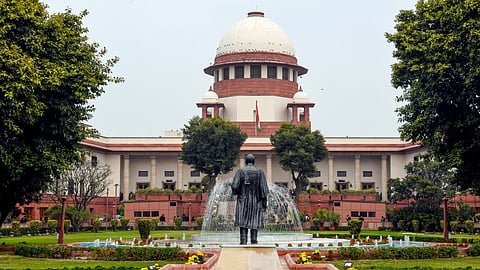

The Supreme Court has acquitted a public servant in an over two-decade-old corruption case involving a trap over an alleged bribery demand, while flagging the "serious lacuna and impatience" of the CBI in the investigation.
The top court, which delivered its verdict on his appeals challenging the May 2024 orders of the Kerala High Court that had upheld his conviction and sentence by a special trial court, noted that "the trap was not permitted to run its full course" and that the CBI could not prove the recovered "bribe" money was meant for him.
It was alleged that the appellant, while serving as the Divisional Security Commissioner of the Railway Protection Force, had abused his official position by demanding and obtaining illegal gratification through subordinate officials acting as intermediaries from RPF personnel seeking transfers, postings and other service-related benefits.
The investigation culminated in the filing of multiple final reports and the institution of several prosecutions based on distinct alleged transactions involving illegal gratification.
A bench of Justices Dipankar Datta and N Kotiswar Singh said there were elements of doubt in the manner in which the trap was executed.
The bench noted that the complainant apparently informed the CBI on August 3, 2005, about the alleged bribe demanded by the appellant and that the probe agency decided to lay a trap the very next day. It said an FIR was lodged on August 4, 2005, and the trap was executed on the same day.
"It is surprising that the CBI started the investigation of a cognizable offence by way of verifying the complaint of bribery even before the formal FIR was lodged. It is also noticed that the CBI arranged the two independent trap witnesses at a very short period of time before the execution of the trap," the bench said in its verdict delivered on September 16.
It said that while the investigating agency could not be faulted for organising the trap in such an "extraordinarily speedy manner", the speed could raise certain doubts about the investigation.
The bench noted that the trial court had brushed aside the doubts raised by the appellant.
"Keeping into consideration the observations made by the trial court in para 150 of its judgment as reproduced above, we are of the view that there are certainly elements of doubt in the manner the trap was executed, which the trial court ignored. The lapses noted by the trial court, in our opinion, raise reasonable doubt on the prosecution case," it said.
It noted that on being informed that the appellant was demanding a bribe, the CBI decided to lay the trap for him.
"It is relevant to consider the reason the trap was not permitted to run its full course as against the appellant," the bench said, adding that if the money was ultimately meant to reach the appellant, the probe agency ought to have kept a watch on him and not merely on the person who was later examined as an approver prosecution witness during the trial.
It said had the investigating agency allowed that chain to complete, the resulting evidence would have spoken far more directly to the appellant's culpability than the recovery actually effected.
"This is a serious lacuna and impatience of the CBI in the investigation conducted by it would enure to the benefit of the appellant," it said.
The bench said the jurisprudence governing offences under the Prevention of Corruption Act had evolved on the fundamental premise that criminality does not arise merely because money changes hands.
"What the prosecution is required to establish is that the public servant demanded, accepted or obtained gratification other than legal remuneration as a motive or reward for performing, forbearing or facilitating an official act. Consequently, proof of demand and acceptance occupies a position of central importance in prosecutions under the Act," it said.
The bench said in view of the "lingering reasonable doubts", the charge against the appellant could not be said to have been proved with the required definitiveness as contemplated under the principle of proof beyond reasonable doubt. While allowing the two appeals, the top court acquitted the appellant of all charges in the cases.
(With inputs from PTI)
