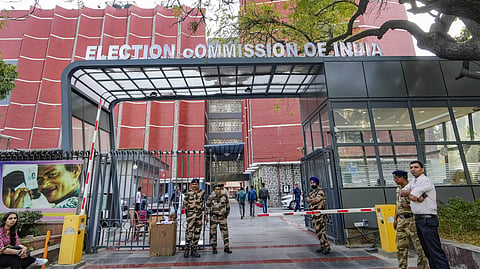

The Election Commission on Wednesday defended its functioning amid a political storm over reported objections raised by two Election Commissioners to decisions related to electoral-roll revision, saying differences during internal deliberations were part of the normal functioning of a multi-member constitutional body.
The poll panel's response came after a report that Election Commissioners Sukhbir Singh Sandhu and Vivek Joshi had formally raised objections at least 14 times over 10 months to decisions and orders they said were taken without their knowledge. The report triggered demands from several Opposition parties for Chief Election Commissioner Gyanesh Kumar's removal and a probe into the functioning of the ECI.
Rejecting the suggestion that such objections indicated a breakdown in the Commission's functioning, the ECI said written notes, observations and technical suggestions were part of its "standard, ongoing practices" and constituted internal checks and balances intended to ensure legal compliance and safeguard voter rights.
"Any operational queries or inputs raised by Commission members during draft stages are part of standard administrative practice aimed at safeguarding voter rights," the Commission said, adding that differing views were part of the decision-making process before a final decision was taken.
The ECI said all official orders, decisions and administrative directions issued by it carried legal sanction and followed statutory procedures under the Chief Election Commissioner and Other Election Commissioners (Appointment, Conditions of Service and Term of Office) Act, 2023.
The Commission also pushed back against the focus on the reported objections, saying that highlighting selected internal notes over a 10-month period without considering its wider decisions and initiatives presented "only one part of the picture".
It said the full Commission had taken numerous decisions, issued instructions and introduced around 40 new initiatives and electoral reforms over the past year, including electoral-roll revision and the SIR, and maintained that these decisions were unanimous.
The ECI also cited the elections conducted in Bihar, Kerala, Tamil Nadu, Puducherry, Assam and West Bengal during the period as evidence of the scale of its work, saying these exercises involved extensive administrative machinery and multiple approvals and instructions.
On concerns over the security of electoral-roll data, the Commission said its digital platforms, including ECINet, operated under strict data-security protocols and audit controls designed to prevent unauthorised tampering or manipulation.
It also clarified that Electoral Registration Officers and District Election Officers exercised their statutory powers over voter registration and deletion under the law.
"The Election Commission of India remains fully committed to executing its constitutional duties with complete integrity, recognizing its vital role in advancing our democracy," the Commission said.
