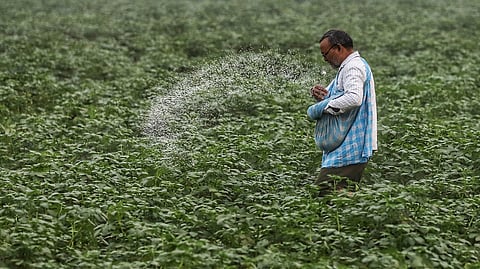

NEW DELHI: In a major push to strengthen India's fertiliser security and reduce dependence on imports, the Union Cabinet on Wednesday approved the National Investment Policy for Urea (NIPU-2026), paving the way for the establishment of eight to nine new gas-based urea plants with a combined production capacity of 10 million tonnes.
The move is aimed at making the country self-reliant in urea production amid rising domestic demand and global supply uncertainties, particularly against the backdrop of the West Asia crisis.
The Cabinet also cleared four key infrastructure projects worth more than Rs 29,300 crore, including two major road corridors to ease traffic congestion in Varanasi, Prime Minister Narendra Modi's parliamentary constituency, and two railway capacity expansion projects in Odisha and Jharkhand.
Briefing reporters after the Cabinet meeting chaired by the Prime Minister, Information and Broadcasting Minister Ashwini Vaishnaw said the new urea investment policy seeks to bridge India's annual production shortfall and ensure long-term fertiliser security.
India currently produces about 30 million tonnes of urea annually against domestic demand of nearly 40 million tonnes, requiring imports of around 10 million tonnes each year. Urea demand is rising by nearly 5% annually, making additional production capacity essential, the minister said.
NIPU-2026 updates the 2012 New Investment Policy by introducing measures aimed at improving transparency and enhancing the financial viability of new projects.
Under the revised framework, fixed and variable costs have been separated to ensure greater pricing clarity, while a return on equity (RoE) band of 12% to 16% has been introduced. The policy also provides protection against foreign exchange fluctuations by converting fixed costs into rupees after four years based on prevailing exchange rates.
According to the government, the revised framework is expected to save more than Rs 250 crore for every new plant established under the policy compared with the previous investment regime.
Vaishnaw said six new urea plants were commissioned over the past decade under the previous policy, significantly reducing import dependence. The proposed eight to nine additional plants are expected to eliminate the country's reliance on imported urea.
The minister said the Fertilisers Ministry had received several proposals for setting up new urea plants, necessitating a fresh investment policy. He added that incentives under NIPU-2026 would be uniform for projects promoted by the private sector, public sector and cooperative institutions.
On the infrastructure front, the Cabinet Committee on Economic Affairs (CCEA) approved two major highway projects in Varanasi with a combined investment of Rs 25,445.96 crore to improve urban mobility and decongest the city's road network.
The first project involves the construction of a 43.218-km corridor linking NH-31 with the Varanasi Ring Road along the Varuna river at an estimated cost of Rs 10,998.32 crore.
The project, to be implemented by the National Highways Authority of India (NHAI) under the Hybrid Annuity Model (HAM), will comprise a predominantly six/four-lane elevated corridor with flyovers, ramps, loops and service roads.
The corridor is expected to provide seamless connectivity between NH-31 and Kashi railway station while improving access to the Varanasi Ring Road, Lal Bahadur Shastri International Airport, Varanasi Junction, Varanasi City station, Deen Dayal Upadhyaya Junction, Ramnagar Port, Sampurnanand Sanskrit University, the city's ghats and the adjoining Chandauli region.
The second project, costing Rs 14,447.64 crore, involves the construction of a 46.039-km six-lane elevated corridor linking NH-19 with the Varanasi Ring Road along the Ganga river.
The project includes an iconic cable-stayed bridge, an extradosed bridge-cum-foot overbridge, link roads, loops, ramps and service roads. The government said the corridor would significantly reduce traffic congestion and improve connectivity across the city.
The CCEA also approved two railway capacity enhancement projects worth Rs 3,907 crore. These include the doubling of the Paradeep-Haridaspur rail line in Odisha and the construction of a fourth line on the Rajkharsawan-Dangoaposi section in Jharkhand.
Vaishnaw said the projects would expand the rail network by about 145 km across four districts in the two states, easing congestion, improving freight movement, and enhancing operational efficiency and service reliability on the Indian Railways network.
