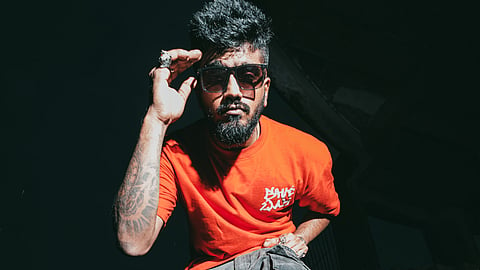

Known as one of the ‘OG rappers’ in Kerala, Shambhu Ajith aka MC Couper belongs to the early wave of Malayalam artists who experimented with the form before it gained wider visibility.
Over the years, he has developed a distinct approach to Malayalam rap, beginning with his first release ‘Nerchappattu’ in 2019. He has written and performed for films such as ‘Aavesham’, ‘Romancham’, ‘Purusha Pretham’, ‘Nadikar’ and ‘Naradan’, with tracks like ‘Mathapithakkale’ and ‘Thalatherichavar’ standing out in recent soundtracks.
Collaborations like ‘Ayyayyo’ — created along with Hanumankind, Thirumali, and Parimal Shais — took him to a wider set of listeners.
Here, in a chat with TNIE, he discusses his journey, his latest track ‘Dayumm’, the recent controversy over one of his live performances, and his thoughts on expression, community, and the evolving hip-hop culture in Kerala. Excerpts
How did you first get introduced to hip-hop?
I got into rap when I was about 12. My brother played Eminem’s ‘The Way I Am’ at home, and it immediately caught my ear. I always liked reading poems. I was more drawn to languages than anything else at school. When I listened to rap, I realised how intricate it was, all the elements of poetry — the rhyme patterns, alliteration, and wordplay — delivered with a raw, contemporary style. That made me want to try it. I also had a blog in school, writing random thoughts, and turned into verses.
After college, unsure of what to do, I moved to Bengaluru and worked as a sports journalist. But after two years I realised it was not my passion. Music had always been a part of my life, but I didn’t have the courage to take it up seriously. When I finally quit my job and returned home, nothing else worked out. That pushed me to pursue what I really wanted. Things slowly started falling into place.
Malayalam rap wasn’t as big as today when you started. How did you end up moving into it?
Writing was the one habit I consistently followed. But for years, I wrote only in English. I never released anything because I didn’t feel confident enough. One day, as I was freestyling while listening to music in the car, a Malayalam line came out unexpectedly. I tried building on it, and that’s when I realised rap wasn’t restricted by language. The first verse I completed in Malayalam felt strong enough to share. That motivated me to work on my debut track. It took almost two years to figure things out.
What does rap mean to you?
Rap is self-expression, how one views the world. It doesn’t matter where you come from or what training you have — if you have something to say, you can say it through rhythm and poetry.

Your fans say you are an underrated gem. Do you feel you haven’t received the recognition you deserve?
That might be because I haven’t yet created something that connects to a wider audience. I feel I held myself back in certain ways. Now I am trying to be more open and present.
Hip-hop has exploded in Kerala, especially with Hanumankind breaking out…
Definitely. Hanumankind’s rise shows what consistent work can achieve. And in Kerala, artists such as Thirumali, Fejo, Dabzee and Baby Jean have pushed boundaries. A few years ago, no one imagined Malayalam rap reaching this point. Even streaming numbers rose because of independent music. All of this gives confidence to anyone dreaming big.
How do you view live shows?
In the beginning, live shows terrified me. But I realised that the energy exchange is incredible. Now I find it exciting, exhilarating.
Recently, clips from your Kannur performance sparked controversy. What really happened?
Some people at the event started abusing artists, and I reacted to that. Later, misleading clips were posted online. What affected me most was the lack of empathy. One guy was doing his first-ever show… it turned into a nightmare for him. But the support that poured
in afterwards was overwhelming.
Rappers are often stereotyped, causally associated with ideas like aggression, drugs, rebellious lifestyle... have you faced such stereotyping?
Yes. I think a few recent incidents have given detractors ammo to degrade rappers. But this is something that applies to all kinds of professions. We are not the only rebels in society, and rebellion has nothing to do with drugs.
Your latest track, ‘Dayumm’, hints at self-reflection. What inspired it?
One day, looking into the mirror, I realised I had grown confident in my craft. Earlier I used to doubt myself a lot. Now I know I am capable, but insecurities still exist and I understand they push me to work harder. The track captures that internal conversation: acknowledging your growth, confronting your fears, and pushing yourself forward.
In ‘Dayumm’, you have used Indian percussion beats, rather than the usual Western-style beats...
I have always wanted to make a song on ‘kuthu’ beats. I hadn’t explored it in my body of work until now, so I was very excited to do it. I knew I could keep the tempo up, and it would be a groovy track.
I wanted ‘Dayumm’ to be like a celebration of self. If you consider our people and our place, these beats are something unique to us. Going forward, I will use more of such beats. I really enjoy the process.
What are your upcoming projects?
A track called ‘Mannira’ with Loozmathai, then ‘Chaappa Kurishu’ produced by Akash Ravan, and ‘Karuppu’ with Aakash Vijayan. A major project with Parimal is also coming up, along with a few film songs.
Cinema has started giving rap a prominent space....
It is a major shift. For Malayalis, film music is still the primary space where new sounds are discovered. My entry into films happened through ‘Naradan’. Aashiq Abu reached out, and my track ‘Nee etha’ was adapted after some rework.
Since then, I have had the chance to collaborate with talented musicians like Sushin Shyam and Yakzan Gary Pereira. Collaborations, to me, are about combining strengths. With so many talented people around, the process becomes creatively rewarding.
Any words for young artists entering the scene?
Be bold, dream big, and trust the process. If you keep working, things will come your way.