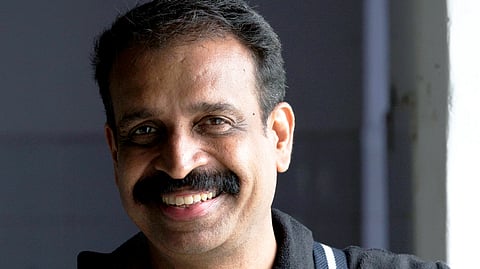

C Bhagyanath has spent nearly three decades exploring the space between text and image. A painter and illustrator first, he has brought a distinctive visual sensibility to Malayalam literature while continuing to develop his creative practice. This year, his contribution is being formally recognised with the first Artist Namboothiri Samman, instituted by the Artist Namboothiri Samman Trust in Kochi to mark the centenary of the legendary illustrator and sculptor. The award, which includes a cash prize of `1 lakh, a certificate, and a sculptural memento by Namboothiri, will be presented by actor Mohanlal at TDM Hall, Ernakulam, on October 18.
A native of Thalassery, Bhagyanath trained at the College of Fine Arts, Thiruvananthapuram, and later at the University of Hyderabad. His works have been featured in both solo and group exhibitions in India and abroad. In a conversation with TNIE, he reflects on his artistic journey, the changing art scene in Kerala, and the recognition that now honours decades of his work.
You have been chosen for the inaugural Artist Namboothiri Samman. How does it feel to receive this recognition?
I’m pleased and grateful. During my school days, I hardly saw illustrations by anyone else; it was always Namboothiri’s works in the weekly magazines I read. I had a habit of reading stories and visualising the scenes in my mind, then sketching them in my notebooks. That’s how I began noticing and appreciating Namboothiri’s art more deeply. His works inspired many of us to join drawing classes and learn the craft systematically. So, receiving the first award in his name feels special.
For an artist, how significant is this kind of recognition?
Unlike cinema or literature, visual art rarely gets public attention. Recognition like this acts like a torch, that sheds light on an artist’s work and helps it find its place in the public space.

Can you share your art journey over the past nearly 30 years in art and illustration?
Like every child, I used to draw a lot in my childhood. My father had a deep interest in art, too. He always wished to draw but couldn’t pursue it because of life’s circumstances, so he encouraged me instead. That’s how I found my way to the School of Arts, Thalassery. While doing my pre-degree at Government Brennen College, Thalassery, M N Vijayan sir was there on campus. His talks, along with the frequent art camps and workshops, inspired me to pursue art more seriously.
You are well-known for your literary illustrations. How did you find your way into that space?
While studying in Thiruvananthapuram, my friends and I used to frequent Thampanoor railway station and bus stand at night to draw sketches of people. One of these sketches reached M T Vasudevan Nair, through a friend, and soon I received a letter from him asking if I could create visuals for a story. He invited me to meet him at the Pankaj Hotel in Thiruvananthapuram, and that’s how it all began.
I was not fully satisfied with that work, so I focused on painting and studies. Years later, an editor from a weekly contacted me and asked if I would be interested in illustrating a novel. That’s how I did my first one — Theeyoor Rekhakal by Prabhakaran N. I was already a big admirer of his novels, and since he was also from Thalassery, his characters and settings felt very familiar to me. That connection made the project even more exciting.
Later, Zacharia invited me to illustrate his work, and I became more active in literary illustration. Currently, I am working on T D Ramakrishnan’s upcoming novel, Korappappanu Sthuthi.
Can you share how you approach the delicate dialogue between text and image?
When I receive a story or novel, I read it three times. First, as a reader, then to let images form in my mind, and finally, to decide what to draw. Since illustrating Aarachar, I have focused on creating visuals that capture the story’s mood without disturbing the reader’s imagination. It’s a constant search to give each illustration its own identity while staying true to the text. Discussions with writers also help shape this process.
Where do you usually find inspiration for your art?
I closely observe the political events happening around us in India, often with a satirical eye. I’m drawn to the absurdities that exist in the name of religion, power, and everyday crookedness — those contradictions and nonsensical realities often become part of my work. In a way, what I do is a kind of visual commentary. I believe art cannot be made; it happens organically.
How do you see Kerala’s art scene changing?
Art today has a wider reach through social media, helping artists connect globally and gain visibility. Many international galleries now discover and showcase works from here. When I started, it was impossible to think of art as a full-time career, but that has changed. Initiatives like the Biennale have made the art scene more vibrant, bringing renowned artists to Kerala and inspiring young talents through discussions and workshops. Also, initiatives of the Kerala Lalithakala Akademi, including the recently inaugurated A Ramachandran Museum, bring new hope to the art scene.
Yet, there is still room for growth. Malayalis don’t recognise artists the way they do actors or writers, nor do they have a strong habit of collecting original art like people from other states. But interestingly, around 60% of serious practitioners in Indian art are Malayalis. Also, when I visit colleges for workshops, I see a promising future with talented youngsters. Those who develop a unique artistic language will get noticed.
On a personal level, what does art mean to you?
My art is a confession to myself. It begins with an internal dialogue, me trying to understand and convince myself about what’s happening around me and how I’m living. When I start working on art, I never think about exhibitions or the market; my process is slow and introspective.