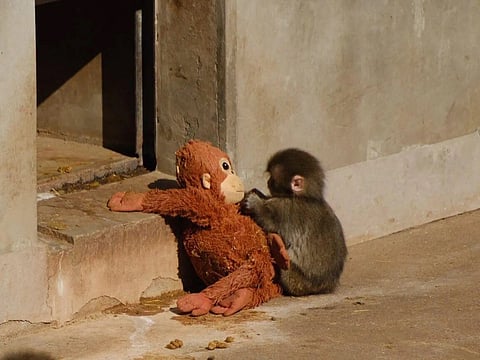

Punch was just days old when his mother abandoned him last July. Helpless and alone, the baby Japanese macaque was saved from death by staffers of the Ichikawa Zoo in Japan.
One of them gave him a stuffed orangutan toy to keep him company. Over the past few days, the little one, clutching the doll for reassurance, has straggled into the hearts of millions across the world.
What drew the world’s attention first was the video of little Punch hugging his orangutan toy, even as other monkeys in the zoo enclosure rejected him. Every time he got bullied or pushed away, he would cling to the doll for solace.
Photos and videos of him, sleeping with or walking while dragging the doll, more than double his size, hit like a punch to the stomach.
When Punch slept hugging the orangutan doll for warmth, netizens from across the globe united to quietly cheer him. They celebrated in relief, as days later, he was hugged by a fellow macaque, and when he finally got another little one to play with. People are now praying that he assimilates with the tribe.
There are many animal videos that go viral. But the Punch story has been unique. Here, it isn’t just about cuteness, or quirkiness. There is something poignant. People, apparently, connect with him emotionally. In fact, many identify with the baby macaque.

But, why?
For Nithya Mariam John, poet and assistant professor of literature at BCM College in Kottayam, Punch’s struggles were “very relatable”.
“We were all born with that sense of rejection, as we were ejected from the womb. That, I believe, stays with us throughout our lives, as we enter new spaces and try to blend in. Perhaps that’s what we are seeing through Punch,” she says.
“We have all been there, playing with our toys by ourselves as our elder, ‘cooler’ siblings and cousins abandon us for their own ‘grown-up’ games. We all have that favourite toy that we took with us everywhere, clutched onto during our loneliest moments.”
Malayalis, Nithya feels, are perpetually touch-starved. “We need to hug more,” she smiles.
“That’s what I felt when I saw Punch sleeping while hugging his stuffed toy, and when, finally, a fellow macaque hugged him. We need our ‘comfort people’ around us.”
Nithya recalls the pandemic days, when the internet coined the term ‘skin hunger’. “Hug your friends, your children, your parents... That warmth, that physical connection, is important to beat modern-day loneliness,” she says.
College student Ayisha Nazla V also relates to the “constant search for warmth”. Punch is now part of daily discussions with friends, she says.
“I have been thinking about the maternal rejection Punch faced. And then his resilience — trying again and again to mingle with fellow monkeys…
Many of us can relate to that loneliness, that craving for comfort.”
The 21-year-old adds that these are times of urban isolation. “Even those who haven’t been truly abandoned can probably imagine the weight of it. I never faced parental abandonment, yet I can relate with Punch and empathise with him,” she says.
Social isolation
Loneliness, after all, is a universal emotion. According to a World Health Organization report published last June, a month before Punch was born, “loneliness is linked to an estimated 100 deaths every hour — more than 8,71,000 deaths annually”.
Social isolation and loneliness are widespread, with around 16 per cent of people worldwide — one in six — experiencing loneliness, the study reveals.
“While estimates suggest loneliness is most common among adolescents and youngsters, people of all ages experience it, including older people (11.8%),” the report notes.
“A large body of research shows that social isolation and loneliness have a serious impact on physical and mental health, quality of life, and longevity.”
And it is this society that this tiny little macaque wandered into with his plush toy. In a world where men are taught to suppress their emotions, Punch has come as a revelation, says mass communication student Gokul Gireesh.
“After watching the videos, many wanted to get closer to their parents. I have been trying to be more open with my parents in recent days. I hope Punch will find his own tribe soon. We all need a healthy support system to survive, be it humans or animals,” he says.
‘Lonely planets’
In January, a ‘nihilist’ penguin went viral as it wandered away from its pack across the icy expanse of Antarctica. The clip came from ‘Encounters at the End of the World’, a 2007 documentary by Werner Herzog.
In the film, Werner and his team observe a lone penguin veering away from its colony towards the frozen mountains, where survival is uncertain. They called it the ‘death march’.
When the clip resurfaced online, the penguin became a symbol of the quiet disconnect many feel today.
A moment where survival itself can begin to feel like a burden. Some saw the ‘death march’ as a metaphor for ‘existence’ burnout. Others saw the spirit of resilience and grit to tread one’s own path.
And now comes a baby macaque, who is lonely amid a crowd. “We feel for them and identify with them, despite them being animals,” notes psychiatrist Dr Arun B Nair.
“We often tend to be ‘lonely planets’ even amidst a galaxy of colleagues, fr,iends and relatives. And in the penguin and the macaque, we see that reflected. Feelings we struggle to express are finding an outlet through their videos and photos.”
Dr Arun explains that people feel so deeply for Punch because, in this largely unknown world, an assured, tangible connection is between mother and her baby. “Something that we automatically assume is ours, and is taken for granted. Seeing Punch being deprived of that stirs empathy in us,” he says.
“And then, of course, the universality of his struggles. The little moments of rejection and setbacks from childhood to our present lives, however trivial they may be, come to the surface as we observe Punch. It’s our inner child that identifies with him.”
Healthy social connections and a quality support system are paramount to surviving the world, he adds. “Punch offers us that lesson — that genuine connection is vital. Quality matters more than quantity,” says Dr Arun. “He inspires us to reconnect with nature, our family and found family.”