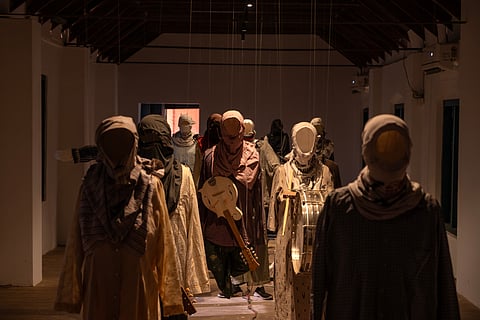

In a dimly lit space at the Kochi Muziris Biennale, music begins to play without anyone stepping forward to sing. There are no visible performers, no musicians taking a bow. Instead, a crowd of hollow, human-sized figures dressed in worn shirts, trousers, and scuffed shoes slowly comes alive with robotic motions. Strings vibrate, melodies rise and fall, and a melancholic rhythm fills the room.
This is Ghost Ballad, an installation by Indonesian artist Jempet Kuswidananto, where a kinetic, bodiless crowd occupies the space, each figure holding a small, portable automated string instrument. The music is triggered mechanically, allowing sound to move through the room without anchoring itself to a visible performer.
Layered recordings of Fado, Keroncong, and related musical forms drift in and out, interwoven with the voices of Goan singer Nadia Rebelo and Indonesian vocalist Giwang Topo.
The installation does not guide visitors toward a single point or moment. There is no centre to gather around and no clear beginning or end to the music. As people move through the space, the sound shifts — sometimes fading, sometimes overlapping, offering fragments rather than a complete composition. Listening happens on the move, shaped by where one pauses, how long one lingers, and what slips past unheard.
For the artist, the absence of bodies is not a symbolic abstraction but a historical proposition. “The hollow bodies reflect the historical absence of the people who carried these songs,” Jempet explains. “Much of this music was created and sustained by ordinary individuals whose names were never recorded. By removing visible bodies, the work points to that erasure.”

Automation allows the music to persist without performers, mirroring how these songs outlive individual lives and continue to circulate as shared memory.
The automation is not incidental either. The small motors that set the instruments in motion produce a steady clicking and whirring beneath the music. Over time, it begins to register as a kind of labour, repetitive and unglamorous, carrying the songs forward without pause. Set within Pepper House, a site originally built for trade and commerce, this mechanical procession sharpens the central theme: between the cold functionality of colonial systems and the fragile human emotions held within the melodies.
Material choice plays a critical role in grounding this experience. The ghost figures are assembled using common clothing and shoes sourced from Kochi and Yogyakarta in Indonesia. “I chose everyday clothing and shoes to emphasise that these histories belong to ordinary people, not distant or heroic figures,” Jempet says.
“Using locally sourced, familiar items anchors the work in lived reality. It connects different geographies through shared experiences — labour, movement, and survival. The clothes function like traces of bodies that have passed through.”
The work draws from a lineage of melancholic musical forms shaped by colonialism across the Indian Ocean. At its root is Fado, a genre of slow, mournful songs that emerged in Lisbon and is traditionally associated with loss, longing, and fate, often sung from those living on the margins. Fado travelled through the Portuguese empire via trade, forced migration, and military routes. As its emotional structure moved across Asia, it was absorbed and reshaped, becoming Mando in Goa, Cafrinha in Sri Lanka, Branyo in Malacca, and Keroncong in Java.
“These are not copies,” Jempet notes. “They are transformations of how ordinary people under colonial rule adopted and reshaped music as a quiet, persistent form of resilience, allowing individuals to express loss and longing where direct resistance was often impossible.” Rather than functioning as protest songs, these genres offered a way to endure.
The political unease surrounding such music became evident in the 1980’s Indonesia, under the authoritarian Suharto regime, when emotionally charged popular songs known as Lagu Cengeng were banned for being overly melancholic and misaligned with state narratives of progress. Jempet later discovered that similar bans had occurred during the Japanese occupation in the 1940s, pointing to a recurring trend under authoritarian rule.
Working in Kochi sharpened the transregional dimensions of this inquiry. “Seeing similar melancholic musical expressions in different places made the connections more tangible,” the artist says. “It made me think about the past less as a national story and more as something entangled. Experiences of loss and survival resonate across regions connected by the same routes of empire.”
Kerala’s coastal history, shaped by centuries of maritime exchange, gives this entanglement a particular immediacy.
These questions sit within Jempet’s broader artistic practice. Based in Yogyakarta, he works across installation, sound, video, and performance to examine Indonesia’s cultural transitions. Using historical notes, interviews, and testimonies, he adopts fragmented staging to illuminate histories that resist clean narration or resolution.
The Ghost Ballad does not monumentalise colonial history or attempt to provide closure. Instead, it allows history to remain as it is, unsettled and unresolved.
Music here functions as a form of memory, because Fado, Keroncong, and their related forms were sung by ordinary people rather than preserved in official archives. Their endurance comes not from staying unchanged, but from being sung, reshaped, and carried forward.