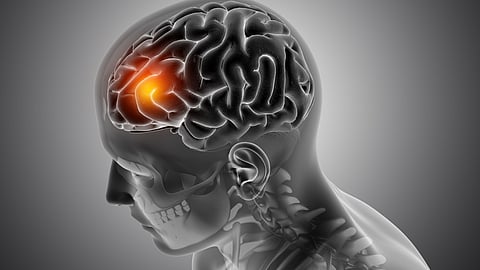

When a stroke happens, life can change in a matter of minutes. Families often tell me later, “He was talking normally just a while ago,” or “We thought the weakness would pass.” But when it’s a stroke, time is of the essence. Every minute a blood vessel in the brain remains blocked, nearly 1.9 million brain cells are lost. Those minutes decide whether a person walks again, speaks again, or returns to their normal life.
What happens during a stroke
A stroke occurs when blood flow to a part of the brain suddenly stops. Most commonly, this is due to a clot blocking an artery that supplies blood to the brain. Without blood, the brain is starved of oxygen and energy.
At the centre of the blockage, damage begins quickly. But around it lies a fragile area called the penumbra—brain tissue that is injured but not yet dead. This is the brain’s second chance. Our race is to restore blood flow before this tissue is lost forever.
Why timing is everything
The brain is extremely sensitive to oxygen loss. The damage progresses silently and rapidly:
In the first few minutes, brain cells begin to fail as their energy runs out.
Within the first hour—the ‘Golden Hour’, restoring blood flow can mean the difference between full recovery and lifelong disability.
After 4.5 to 6 hours, the risk of permanent brain damage increases. But with modern imaging and advanced treatment, selected patients can still benefit even beyond this window.
But the earlier a patient reaches us, the better the outcome—there is no substitute for time saved.
Modern stroke treatment saves live
In the past, treatment was limited to clot-dissolving medicines given through a vein. These medicines still help many patients, but large clots often require more.
Today, Mechanical Thrombectomy has transformed stroke care. Using minimally invasive techniques, we guide a thin catheter through the blood vessels—usually from the wrist or groin—to directly reach the blocked artery in the brain. With specialised devices, we remove the clot and restore blood flow.
Protecting independence
Fast treatment not only saves lives—it preserves the quality of life. By acting quickly, we can prevent:
Permanent paralysis
Loss of speech
Memory and thinking problems
Long-term dependence on others for daily care
Every minute saved reduces the burden on the patient, the family, and the future.
Recognising a stroke early
Even the most advanced treatment can only help if the patient reaches the hospital in time. Please remember BE FAST:
B – Balance: Sudden loss of balance or coordination
E – Eyes: Sudden vision loss or double vision
F – Face: Facial drooping
A – Arms: Weakness or numbness in one arm
S – Speech: Slurred or difficult speech
T – Time: Call emergency services immediately
Do not wait. Do not hope it will pass. Do not lose precious minutes. In stroke treatment, we are not only fighting a clot—we are fighting the clock. Quick action can mean the difference between a life returned and a life changed forever.
If you ever notice stroke symptoms in yourself or someone you love, act immediately. Because when it comes to the brain, every minute truly matters.
