
Step into the sprawling, cavernous expanse of a Willingdon Island warehouse this week, and you will find yourself transported far from the industrial docks of Kochi. Instead, you are invited into the heart of rural Palakkad, where the Lakshmi Nivas Collective has manifested a world where the boundaries between humans, animals, and the earth begin to blur.
Established in 2018 in the village of Parudur by artist Sunoj D and researcher Namrata Neog, the collective’s practice is rooted in the study of seasonal rhythms, specifically herding and foraging. For the current edition of the Kochi-Muziris Biennale, they have brought these rural “entanglements” to the city through a powerful trio of artworks.
“The sculpture installation and video works are born from an ongoing everyday practice,” says Namrata.
In a terrain where the division between the human and non-human is porous, rituals become enmeshed with the land, nourishing and healing one another through a shared sense of precarity and kinship.
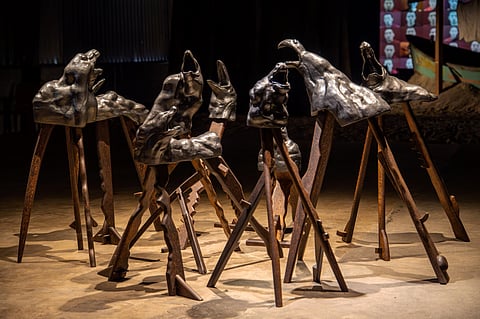
The exhibition contains three artworks held in a conceptual dialogue. These works highlight the anthropocentric features of our world. ‘Resistance Prayer Song’ has dark, striking sculptures featuring clusters of animal torsos caught in a ‘collective howl’.
Crafted from fired terracotta and graphite, materials found in the oldest archaeological sites in Palakkad, artists have used indigenous palm wood from northern Palakkad and Tamil Nadu to imitate the texture of skin.
The work suggests that where there is prayer, there is an inevitable resistance on the other side of the spectrum.

In ‘Faith Was Never About Us’, forms resemble gnarled roots rising from the floor. Artists have used red oxide mixed with cement, resembling the traditional flooring of homes along the coasts of the Arabian Sea and the Bay of Bengal.
At the same time, ‘Wait’, the video installation, serves as a bridge between the two sculptures. Captured during the Kerala monsoon, a pivotal season for local agriculture, the film moves at a slow, peaceful pace. It asks visitors to abandon the urban rush and synchronise with the steady, patient temporality of the seasons.
“Prayer acts as a belief system for the sustenance of human society,” Namrata suggests. Though it is humans who practice the act of prayer, the focus here is on animals and plants, akin to small localised rituals.
“We pray for our crops and animals, but what are we actually praying for? We pray for our own food security and economics; we pray for a single crop or a specific animal, but we miss the entire spectrum of non-human entities. For example, we don’t pray for a weed or a tick!” she says.
Their work poses difficult questions: Why do we label certain animals as ‘friends’ and others as ‘threats’? Who determines what is ‘domesticated’ versus ‘wild’, and how do these definitions manufacture hierarchies of utility?
Ultimately, the collective probes the essence of existence — why do we farm, herd, or domesticate? Why do we maintain a relationship with plants and animals at all?
According to Sunoj, the collective is not merely delivering a message, but attempting to decipher the complex agency of humans within a landscape.
In an era of increasing disconnection, the collective asks: “Where are we today in relation to a tree or an animal?”
“Art is something anybody and everybody will feel. It’s not a placard that sends a message. People come with their own baggage, their own experience, and their own aesthetics. You engage with the art that way,” says Sunoj. The same is true here. In a warehouse, people confront nature and its inhabitants.
By placing these earthy, primal works within the industrial grit of a warehouse, the artists offer a poignant reminder: even in our modern, built-up world, we remain deeply and inextricably rooted in the soil.