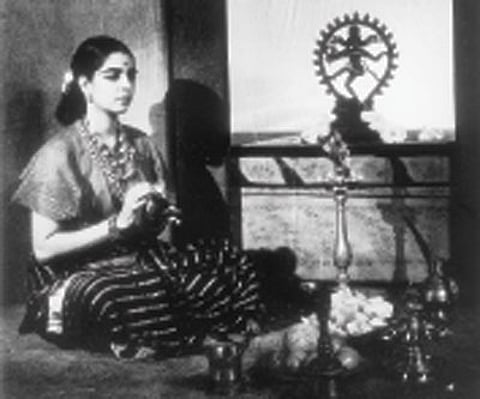

Rukmini Devi always stood out: as a child who spoke up against corporal punishment, a large-eyed girl with a long line of admirers, and as somebody who silently defied social conventions. Leela Samson’s biography of the dancer and social activist brings out her radical side as well.
Rukmini’s childhood was shaped by her father who disapproved of crudity and lewdness, a Brahmin attracted to Buddhism, a traditionalist who sympathised with women who suffered from Hindu orthodoxy. He pledged his support to social reform and that led to his association with the Theosophical Society.
Samson revisits this period gracefully in Rukmini Devi: A Life, pointing out not just the highlights of the Society, but also telling the reader about the controversies that the fledging movement had to face on foreign soil. The social activism and intervention of the Theosophists — in diverse ways, such as taking up the cause of labour unions and textile workers or providing education to the depressed classes — is brought out diligently. Likewise, she takes pains to tell in parallel the story of J Krishnamurthy — his indoctrination, involvement and later estrangement from the Theosophists.
Her father’s deep connections with the Theosophical Society led to a love affair and, in a move that shocked traditionalists and scandalised liberals, 16-year-old Rukmini married 41-year-old George Sydney Arundale, an English aristocrat and vital figure among Theosophists. Severely criticised by the newspapers of the day, the storm over such a cross-cultural marriage subsided over time, and Rukmini and Arundale soon went to work for Annie Besant at Adyar.
A European tour shortly thereafter
altered their lives irrevocably. At 22, she
accompanied her husband to Australia, where he was general secretary of its unit of the Theosophical Society. She travelled with him all over Europe and the United States. Back in India, she was consecrated as Rukmini Devi by Annie Besant.
Her long-term association with Anna Pavlova kindled her interest in dance. In 1932, for the first time, Rukmini watched the Pandanallur sisters perform. She fell in love with it, and she yearned to learn it too.
Refused the tutelage of the dance-doyen Meenakshisundaram Pillai at first, she
began learning form from Gowri Ammal, a devadasi who served in the Kapaleshwar temple. Later, convinced of her genuine commitment, Meenakshisundaram came to Chennai to teach Rukmini. She became the first Brahmin woman to learn the Sadir, even as members of her community had signed and circulated a pledge never to witness a Sadir performance and also discourage others from doing so.
Rukmini Devi gave her first public performance in 1935, hardly two years after she had started learning. Two years later, she had established an academy to teach dance with just ‘one tree, one pupil and one teacher’, which is Kalakshetra, one of India’s premier dance-schools.
She was a revolutionary woman: in her first performance at the Natarajar temple in Chidambaram she chose to dance Varugalaamo ayya, a composition identifying with Dalit devotee-martyr Nandanar who was killed in his day for seeking entry into the portals of the same temple.
Samson’s devotion to history ensures that Chennai — with its political climate, cultural heritage and zeal for reform — comes across as another character in Rukmini Devi’s life. She tracks the story of how Rukmini Devi single-handedly strengthened Kalakshetra after a fallout with the Theosophical Society. These anecdotes of how she struggled through the litigation, or how she silently managed cancer, bring out her susceptible, human side.
You outline hardly half-a-dozen instances of having personally interacted with Rukmini Devi. Why did you push yourself into the shadows? Isn’t it unusual for a biography?
It is an obvious answer for anybody who knew Rukmini Devi. With a personality like her, you are in the shadows. She was a powerful individual, a complete person. There was a sizeable age difference between us; besides, she was a guru and I was a shishya, actually quite low in the hierarchy of shishyas. Writing about a guru is not easy, and when the guru is someone like Rukmini Devi, it becomes very difficult. When you write about a life that encompasses so many things, you
really don’t have space for anybody else.
Rukmini Devi was a strong and radical woman; so, how difficult was it for you to also write about her vulnerability?
I think one has to face reality. She had her weak moments. All of us are human, nobody is a saint. She was not a good judge of people and often entrusted the wrong person with the job. On the other hand, for the kind of work she was doing, it was all right to have one or many faults, since the work was so much more important than anything else.
You don’t let the controversies between the Theosophical Society and Rukmini Devi turn into a mudslinging match. What helped you in this concise and eloquent choreography of the text?
I don’t think it was a mudslinging match, but there was a lot of bad blood over it. She wasn’t always right. You could even say she was legally wrong. This was her baby, she created it, she put down every stone — how could anybody come and take it away from her? That was the sentiment that guided her.
There was no guidance on what I chose to reveal, I went by instinct. I am not a confrontationist, but I say what has to be said even if it is not palatable. I spent a lot of time with both sides of the story and I feel that she should have been advised correctly through that. After all, artists are vulnerable.
Rukmini Devi is this true renaissance woman, an activist who took up social concerns that lay outside of dance. As her disciple, and as director of Kalakshetra, what do you think is the role that artists can play in today’s fragmented society?
The problem with being an artist is that you spend so much time correcting form, in becoming that perfect artist who can survive the market and say something with an element of truth. You don’t have time not just for society but also for yourself, for family, for a good marriage.
Some people negotiate, but there’s an element of sacrifice. I know many artists who are activists inside. I think an artist can influence hugely. As an artist who has put her career on the backburner and made the institution my priority, I reach out to society. Making connections between all kinds of artists, bringing the sense of beauty of life into the lives of those who work and live on campus, these are things which ensure that art is taken to a larger spectrum.
You lament the fact that Rukmini Devi’s works haven’t been properly archived; what do you feel about the preservation of history?
We don’t have a sense of history in our country. Any other country would have written copious biographies. One of the things I have taken up very seriously is that we have to get the history of the
institute and Rukmini Devi documented. We are about to start a museum — the history of Bharatanayam will run concurrently to her life because that century encompassed the struggle and the renaissance leading to the development of the dance form by Rukmini.
Everyone knows Rukmini Devi removed the erotic in her effort to sanitise Bharatanatyam, but you speak of how she worked against narastuti (the deification of individual patrons). Your biography doesn’t quite sing her praises, right?
If I did that, it would belittle her a little. She was very private. She never praised us if we danced well. It was never her way.
Your experience with writing this book?
I would rather do a kutcheri. There, I at least know what I have to do.
Meena Kandasamy is a writer and translator whose debut poetry collection was published in 2006. meena84@gmail.com
