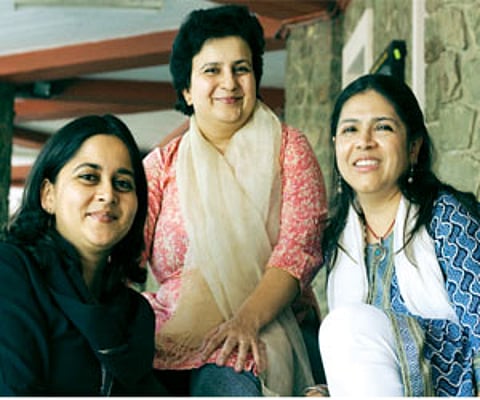

Mumbai is generally considered to be one of the safest cities for women in India but this is an image that often masks some larger questions about their inclusion in the urban space. Are women granted access to public spaces on equal terms with men or do they constantly negotiate or justify this space? Written over three years by Sameera Khan, Shilpa Phadke and Shilpa Ranade, Why Loiter? argues that women from across classes face different levels of exclusion from urban public spaces. They say it is only by embracing the act of loitering, an exclusive preserve of men in India, that a truly global and equal city can be created.
Excerpts from an interview with the authors:
What kind of research did the book involve?
Sameera Khan : The book was born as a result of research at the urban
research collective, PUKAR or Partners for Urban Knowledge Action and
Research. The Gender and Space research project, as it was then called, queried women’s access to public spaces in the city. We used many different multi-disciplinary research methodologies including ethnography, pedagogy, visual media, architectural mapping and focus group discussions with women across locality, class and community.
We decided to write a book based on our findings — but it does not exhibit each and every finding of ours. Rather, the findings are the take-off point to discuss what is happening to the city, the changes within it, the real issues of women’s access, the many negotiations that women have to make to access public spaces, often even without realising, and then eventually we make our case for women, as well as all other groups of citizens including the marginalised, to have the opportunity to take pleasure in the city by hanging out, to loiter.
Shilpa Phadke: We conducted interviews and focus group discussions in several localities across the city — we tried to cover middle-class neighbourhoods like Chembur and Mulund, business areas like Nariman Point and SEEPZ, working class areas like Kala Chowki, upper class areas like Malabar Hill and Pali Hill, community neighbourhoods like Girgaum and Dongri, gated communities like Lokhandwala and Hiranandani. We also interviewed women pavement dwellers. These discussions were revealing.
Mumbai is generally seen as one of the safer cities for women. Was that a factor in your choosing to conduct the study there?
Sameera Khan : If Mumbai was the city (of all Indian cities) that offered Indian women unparalleled access to public spaces, we were keen to understand what type of access, what facilitated that, and could that be improved upon. We looked at issues of safety and comfort in public space, material design of the urban spaces and how that influenced women’s access, attitude towards women in public for work and for fun.
As women gain greater access to public spaces more cases of sexual violence seem to be reported. Would you say this is because they are not accepted on equal terms?
Sameera Khan : Women are generally seen by society to belong to the private space of the home. Their engagement with public space has always been limited and not encouraged.
So yes, one way of reading the violence against women in public is to say that society does not want them out there or does not accept their presence in public. But we would argue that the media by consistently reporting incidents of public violence against women has created a false image of the home as a ‘safe’ space and the public as a space of great danger. And if we look at crime statistics across the country that is just not true. Most violence against women is in the private space of the home. Yet the media often
ignores domestic violence and plays up public violence against women especially in urban spaces.
In the book you make some suggestions about redesigning public spaces to make women feel a part of them. How do you take this research forward?
Shilpa Ranade: Our research has shown that the material design of space goes a long way in making women feel more comfortable. Often the design of public spaces imagines a ‘neutral’ user of the space and more often than not this neutral user is an upper class, upper-caste, able-bodied male.
One of the first things we can do is make design professionals aware of the impact of design on access for women and other marginalised groups.
We have tried engaging with architecture students through courses and
workshops. We also need to get more women involved in decisions such as city planning.
Shilpa Phadke : We discovered that lighting was a very important element adding to women’s sense of comfort in a space. In a study of 35 suburban railway stations we examined particularly, adequacy of lighting in terms of perception of brightness and context. For instance, corners, staircases and foot-over-bridges often need brighter lighting as these are seen as dangerous spaces. The areas of concern we found were: Toilets were badly lit; the staircases on the foot over- bridges often had only one tubelight. We submitted our report to the Central Railway and were pleasantly surprised to find a few weeks later later that they had actually augmented lighting in many places based on our recommendations.
What is your opinion on the role of media in these cases?
Shilpa Ranade : The role of the media in discussing women’s access to public space is complex. While on the one hand it definitely raises awareness of the issue, the tone of the reporting can tend to reinforce the idea that public space is unsafe for women. This is contrary to research that shows not only that women are more vulnerable to violence in their homes than in public spaces but also that more men get physically assaulted in public spaces than women.
The perception of public space as being dangerous further limits women’s access. In a focus group discussion after the Marine Drive rape case, for example, many young women felt that the attention the case got would lead to increased policing of their access to public space by their families.
Secondly, the media often tends to focus on the big stories like rape, overlooking the everyday negotiations and strategising that women have to undertake in accessing public space. It is these small, often unconscious, everyday actions that reinforce the idea that women do not have a claim to public space and are responsible for manufacturing comfort and safety for themselves.
— jayantsriram@expressbuzz.com
