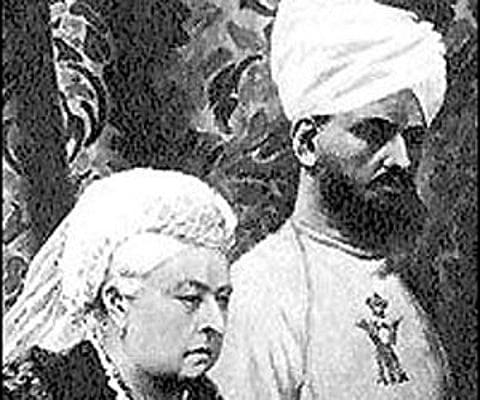

Historical romances as a genre are embellishments of the times they are set in, but romantic history is a singular vein. Victoria and Abdul, Shrabani Basu’s captivating account of the relationship between an empress and her Indian assistant, is a seance with history, that begins with the author finding Abdul Karim’s diary—“a neat brown journal with golden edges.” Victoria, delighted with the title ‘The Empress of India’, wants to show her empathy to her ‘subjects’—Indian kings and queens who were to arrive in London for the Golden Jubilee celebrations.
Basu’s telling of this story about a unique relationship that puzzled colonial England, angered the royal household while sketching the biography of a native with “aesthetic tastes”, and draws back the curtain on life in the Victorian court as well as on the complex politics of India after the 1857 Mutiny. The pen-portraits Basu draws, says a lot in so little: the Maharaja of Indore “a burly, ill-mannered vulgar Maratta” in the words of Lord Dufferin; her detailing exquisite: “the Queen’s black dress trimmed with exquisite white point d’Alecon lace and diamonds”. Basu’s research is extensive, and executed with the flair of a talented writer of fiction; the daguerreotypes that emerge are that of a lonely, widowed queen who places deep trust in a Indian, whom she sometimes addressed as “best friend”, sometimes as her son.
By a quirk of fate, Karim was asked to select carpets and bangles for the queen, to be sent as presents from India in 1886. Impressed by his taste, British officials in Agra sent him to London to serve in the royal household.
Basu’s visual retelling of history is cinematic in its treatment; writing about the first Indian Durbar she describes its pomp and pageantry with the amused eye of a journalist: an Indian prince finding it difficult to kneel before Victoria in order to be knighted, not because of his pride but because his clothes were too tight.
Karim’s relationship with the queen is investigated in detail. The picture that emerges is that of a ageing woman fascinated by the Orient; Karim’s “soft voice” is the magic carpet that transports her to the exotic part of her Empire. The valet teaches her Urdu, enchants her with the love story of the Taj Mahal, cooks Indian curries for her—long before chicken tikka masala became Britain’s favourite food. Abdul Karim played the role of a male Scheherazade, bringing the culture and folklore of distant India to the Empress of the world; Victoria would go on to write diaries in chaste Urdu.
The proximity of an Indian to the Queen of England naturally inflamed those at court, especially the royal family. Court politics was to lead to Karim’s downfall eventually, though Victoria defended her munshi till the end, instructing that he be given all honours after her passing, which he enjoyed during her reign.
The bewilderment of Karim in racist Britain, especially in the royal household, is portrayed well, both during his rise and fall—whether acting in royal plays or watching the queen’s letters to him being burnt on King Edward’s orders. A highly readable book for anyone who wants to understand Victorian India and its complexities.