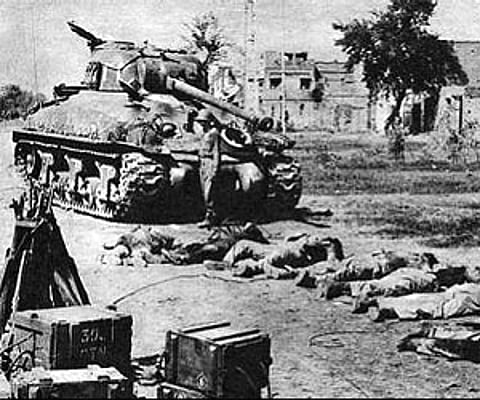

At a time when the world perceives the Pakistani army as a brutal terrorist organisation, a book written by an Indian has come to its rescue. Dead Reckoning, by Sarmila Bose, Netaji Subhash Chandra Bose’s granddaughter—looks kindly at the Pakistan army’s role in the 1971 Bangladesh war. Bengali nationalists have called Bose “an apologist for Pakistan’s brutal military”, reports Al Jazeera. The book appears at a sensitive time; Sheikh Hasina’s Bangladesh government has set up special tribunals to try the “war criminals” of 1971—mainly Bangladeshi collaborators made up of the so-called peace committees, or the Razakars militia.
The Awami League, led by Hasina’s father Mujibur Rahman headed the Bangladeshi secessionist movement, after Pakistan’s junta rejected the popular mandate in the 1970 elections.
“We have reasons to believe that there is a concerted campaign by Pakistani intelligence to disrupt and dilute our War Crimes Trial.
I will not be surprised if they are commissioning projects to distort the realities of our liberation war,” Shamsul Arefin, a war crimes trial official told Al Jazeera, an accusation that Bose refutes.
“I am only trying to question the existing narratives of the 1971 war, in view of data I have gathered while working for the book,” she told an audience at the Woodrow Wilson Centre in US, where the book was launched. “I am only pointing to obvious exaggerations about the number of people killed or number of women raped by the Pakistani army.
A war narrative is always that of the victors, and 1971 was no different,” Bose said at the book launch.
According to her, only 34,000 Pakistani troops were stationed in East Pakistan during the 1971 war.
In the book, Bose questions Bangladeshi accounts that 4,00,000 women were raped by Pakistani troops between March and December 1971; how can 34,000 soldiers rape so many women in eight months, she asks.
Historian Jayanta Ray, who had predicted the partition of Pakistan in his 1968 book Nationalism on Trial told Al Jazeera that Bose has got some basic facts wrong.
“Records indicate that just over 93,000 Pakistani soldiers surrendered to the Indian army in December 1971. They were all handed back to Pakistan. That’s thrice the number Bose suggests, so is she fudging figures deliberately to prove that the number of rapes were much lower than suggested?” asks Ray.
According to Bangladesh’s anti-fundamentalist campaigner Shahriyar Kabir, Red Cross officials testified in 1971 to treating nearly 200,000 rape victims.
Indian army officers refute her conclusion that “India was the only aggressor in 1971”. “How can she call us an aggressor?” former chief of India’s eastern fleet, Vice-Admiral Bimalendu Guha told Al Jazeera. “Bengalis actually wanted us to intervene earlier to save them.” Former chief-of-staff of India’s eastern army, Lieutenant General J R Mukherjee mocked Bose by saying that she describes the Pakistani army as a professional and brave force. “Can I ask her why these brave soldiers surrendered to India in such a huge number? Even now, Pakistani troops keep surrendering to the Taliban and other militants. Can you show one Indian soldier who has ever surrendered to a militant?” Jayanta Ray also alleges that Bose’s sources are primarily Pakistani. “She has interviewed many Pakistani officers, but not those who were fighting then,” says Professor Ray.
Numerous Bangladeshi freedom fighters—the Mukti Bahini who fought the Pakistanis in 1971—are fuming at Dead Reckoning.
“How can a Bengali, and that too from the family of one of our greatest leader Subhas Bose, write such a horrible account that tries to defend Pakistan’s brutal army?” Haroon Habib, an ex-Mukti Bahini fighter asked Al Jazeera. Bookshops througout Bangladesh have boycotted Dead Reckoning. It’s missing on Calcutta bookshelves, too.
The author’s defence is she “tried to correct the course of contemporary history”.
Sarmila Bose is a senior research fellow at Oxford.
Meanwhile, a new film Meherjaan—based on the love story between a Pakistani soldier in East Bengal and a Bengali woman—by Bangladeshi filmmaker Rubaiyat Hossain has generated a similar outcry in Bangladesh, though famous Bengali Indian actors like Jaya Bachan and Victor Banerji star in it. “I was raped several times by Pakistani soldiers, and I cannot stand this soft corner for Pakistanis in the film,” sculptor Ferdous Priyabashini told Al Jazeera.
Hossain says she was only trying to break out of the stereotype of the Bengali hero versus Pakistani brute in the backdrop of 1971. It is still a sore point with Bangladesh that Pakistan has not apologised for the army atrocities of 1971.