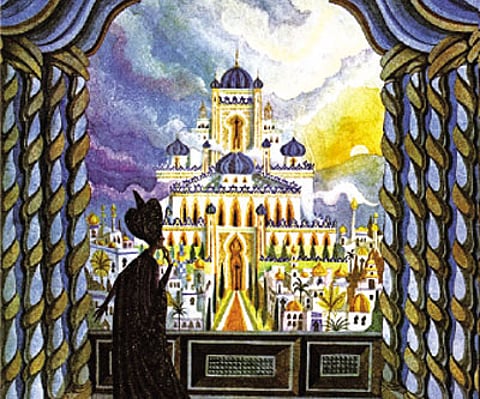

Few books have evoked the visual imagination as The Thousand and One Nights — an exceptional, even aberrant work, with respect to some of the most important conventions of medieval Arabic literature. Princess Scheherazade, Aladdin, Sinbad the sailor and Ali Baba have acquired the status of cultural icons. Genies, flying carpets and magic lamps, once curiosities of medieval Arab and Persian mythology, are now stock-in-trade of Occidental fantasy. There have been musical interpretations by Rimsky-Korsakov and Weber; cartoons by Disney, and lavish Hollywood films.
The reason, perhaps, lies in the genesis of the stories. As Borges said of one of his favorite books, Seven Nights, “To erect the palace of The Thousand and One Nights, it took generations of men, and those men are our benefactors, as we have inherited this inexhaustible book capable of so much metamorphosis.” The ‘palace’ of the Nights is based on 19th century editions from Egypt, India and Europe, that have served as the basis for all but one translation since Galland’s first. With its spacious pavilions, charming recesses, secret chambers and mysterious passages, it must have been the work of many literary hands, and the result of seven or eight centuries of development in Arabic alone.
Robert Irwin’s Visions of the Jinn: Illustrators of the Arabian Nights, is a remarkable tome that provides us the visual history of this timeless story. Part bibliographical exposition, part dazzling magic lantern show, its 164 colour facsimiles, photographs and B&W images, and their accompanying analysis, offer a stunning and sensitive account of the European response to this titillating text.
The first edition contained no pictures, but the late 18th century saw illustrated editions flourish. The first was a widely pirated 1714 edition with engravings by Dutch artist David Coster, who portrayed the characters in European dress, and on European furniture amid European architecture.
It wasn’t until the 1839-1841 translation by Edward W Lane, that the stories began to reflect the Arab world with some accuracy. Lane hired British engraver William Harvey to do the artwork, and gave him historical engravings of Egyptian and Moorish architecture to copy, approaching it as an educational primer rather than a visual journey.
The first imaginative edition, titled Dalziel’s Illustrated Arabian Nights Entertainments, came in 1865, with engravings by a number of notable artists, including Sir John Tenniel, famous for his whimsical illustrations in Lewis Carroll’s Alice’s Adventures in Wonderland. Walter Crane, in his 1876 Aladdin’s Picture Book, introduced colour, and was among the first to consider children.
Even though editions since Lane’s scholarly work progressed in visual imagination, the content remained rather sterile. It wasn’t until the 1885-1888 Richard Burton translation, that themes of sexuality and bestiality emerged. Burton’s original had no pictures, but shortly after his death in 1890, Albert Letchford created 70 paintings, which became the basis for the next edition of Burton’s translation.
In the early 1900s, Edmund Dulac illustrated Stories from the Arabian Nights (1907), Princess Badoura (1913), and Sindbad the Sailor & Other Tales from the Arabian Nights (1914), blending British tradition of illustration with vibrant colours of Persian miniatures and motifs from Chinese and Japanese art.
By the early 20th century, artists had abandoned ethnographic accuracy. Illustrators like Danish artist Kay Nielsen looked to fantastic monsters and whimsical landscapes of Asian folklore, weaving Buddhist iconography, Chinese cloud bands and surrealist elements into the stories.
It is towards the end of the century, and of Irwin’s book, that things really get exciting. Recent illustrations combine contemporary knowledge with indigenous design and an explosion of colour. Among these are British artist Errol le Cain. Visions of the Jinn explores these and other treasures, as well as the context in which they were created, to paint a vivid mosaic of the visual legacy of Arabian Nights.
