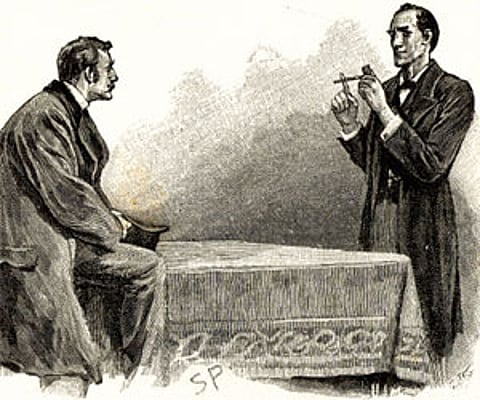

The heart is where the Holmes is. Two new Sherlock Holmes tomes, T he House of Silk by Anthony Horowitz—the first novel to be officially approved by the Conan Doyle estate—and The Sherlockian by Graham Moore, in which a prominent member of Doyle’s estate displays villainous tendencies that may make Moriarty proud, are the latest additions to the canon.
Long after the death of Holmes and Doyle, Sherlock lives on in pastiches; new stories ‘discovered’ or invented by Holmes-fans like Paul Andersen’s Time Patrol, Julian Symmons’s Three Pipe Problem and John Dickson Carr’s The Exploits of Sherlock Holmes. There is Indian Sherlockiana, too: Partha Basu’s The Curious Case of 221 B and Jamyang Norbu’s The Mandala of Sherlock Holmes.
Moore’s style is almost automatic writing, as if Doyle himself is essaying forth in his clear and economic Victorian manner. His protagonist is not Holmes, but Doyle, who is jealous of his detective’s popularity and gets assaulted by angry old ladies and with letter bombs. “He has become a waste of my time. If I have to concoct another of those tortuous plots—the bedroom door always locked from the inside, the dead man’s indecipherable final message, the whole thing told wrong end first so that no one can guess the obvious solution—it is a drain... To put it frankly, I hate him. And for my own sanity, I will soon see him dead.”
Bram Stoker, who plays Watson to Doyle’s Holmes, doesn’t agree. The famous quote from Dracula comes handy here, “Unless my senses deceive me, the old centuries had, and have, powers of their own which mere modernity cannot kill.” And the game is afoot. An accomplished Sherlockian is murdered at a Baker Street Irregulars convention in New York. The motive: a missing Doyle diary. Off go sleuthing young Irregular Harold White, accompanied by the mysterious Sarah who seems to have an angle of her own. Bodies pile up, Doyle goes to prison and is saved by a Scotland Yard inspector who resembles Lestrade.
In The House of Silk , Holmes is framed and sent to gaol for murder and is bailed out with Lestrade’s help. Horowitz’s Watson is old and introspective, and has decided to tell the last tale. 221B Baker Street is resurrected to the dot: the London fog; the ragged strains of Holmes’ Stadivarius; Miss Hudson’s hot scones; a mysterious American adventuress and her devoted husband. Children live in savage deprivation and die by violence. Moriarty (“I’m a mathematician, Dr Watson, I’m also what you would doubtless term a criminal”) tips off Watson to help Holmes, and the climax is classic Conan Doyle.
The mystique of Sherlock Holmes is that he is immortal. He walks the centuries wearing his deerstalker cap and smoking his pipe, dealing in death and combating evil everywhere. The denouement never disappoints. Doyle says in The Sherlockian , “I know it seems impossible now, but it will all work out. You cannot see where I’m going, but I can, and it will delight you in the end.” Each pastiche, each new novel, will continue to mystify and delight for generations: “Elementary,” said he. “It’s one of those instances where the reasoner can produce an effect which seems remarkable to his neighbour, because the latter has missed the one little point which is the basis of the deduction.”
No shit, Sherlock. Or Moore. Or Horowitz.
