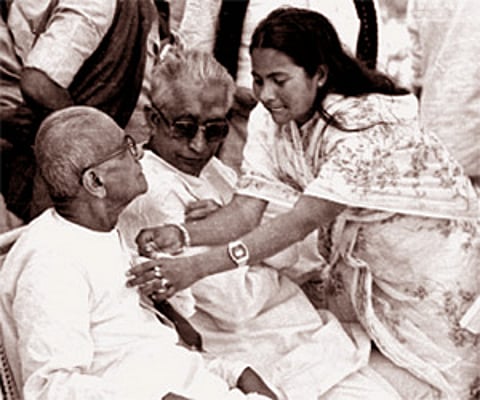

As one of India’s most fiery leaders, everyone knows Mamata Banerjee. Her impulsive yet daring nature, meteoric rise in politics, tenacious fight and eventual victory over the Left in West Bengal, are well-known. But maybe it was time to tell Didi’s real story — that of a young girl from the squalid bylanes of Kalighat in Kolkata and her journey to Writers’ Building. The West Bengal Chief Minister’s memoirs, My Unforgettable Memories, published by Roli Books, is a translation of excerpts from her published Bengali works. It traces the mercurial leader’s life from her childhood, to college and state politics, and her emergence as a powerhouse on the national stage.
While it doesn’t cover the pinnacle of her success, the decimation of 34 years of Left rule in last year’s Assembly polls, it provides gripping insights into the quirky, humble and sometimes naughty Mamata Banerjee. She writes at length on her equation with the late PM Rajiv Gandhi, calling him her mentor, while criticising his wife Sonia Gandhi and divulging her feeling of betrayal at the hands of the Congress. Referring to Sonia as the ‘Queen Mother’, Banerjee says, “The culture in Congress is that when a regional faction gets too active, it’s immediately censored by the top leadership.”
Didi’s journey from street fighter to the tumultuous Nandigram days might make for an interesting read, but the true charm of the book lies in the hitherto unknown secrets of the TMC supremo, such as her belief in the occult and supernatural, serendipity and providence. All through her life, she has believed that certain occurrences, like the coming of rain, have bided well for her. She says, “According to my mother, it had rained relentlessly for three days before I was born, but it stopped raining the moment I was born. That’s perhaps why rains play such an important role in anything significant I undertake.”
While she calls herself an outsider to the “neatly manicured garden” of Parliament, what really comes across is her outsider status to gentility. Ever self-effacing, she describes how, during her trip to New York as a UN delegate in 1998, she used a saucepan to shower as there were no mugs in the hotel room, much to the bewilderment of the cleaning lady who found the utensil there. She also picked chapsticks as gifts thinking they were lipsticks. These tidbits humanise one of India’s most influential leaders.
The 190-page autobiography is perhaps her way of reaching out to a larger audience, keen as she is to tell her own tale with honesty and aplomb. Her stories, emotions and sheer grit leave the reader feeling inspired, as they are left wondering how far, the teenage girl in the B&W snap wearing a short skirt, has actually come. It’s the image imprinted on the mind long after the book is over.
