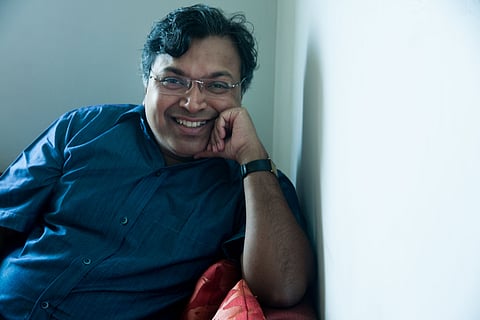

Our country has always been a land of stories, being told and re-told, carried from generation to generation. From the ancient guru-shishya parampara where tales were narrated as a part of the curriculum to the written word like the Ramayana, Mahabharata and more — epics has always been a part of our fabric of life. When more visually attractive mediums like theatre and television started entering the scene, ancient chronicles continued to enchant through the yearly enactment of Ram Leela at Ram Maidan, New Delhi or the nostalgic re-runs of Ramanand Sagar’s Ramayan.
Cut now to animated television series, audio books and much more — the stories of the past still resonate with us, regardless of the medium. Devdutt Pattanaik is one of the rare storytellers, who through different mediums, has successfully spread the stories of India far and wide. “Human beings yearn for meaning and identity to give value to their life. We want to know where we came from. And so, ancestry matters and the story of ancestors matters,” says the 45-year-old author, illustrator and TV show host. Continuing in the same vein, he adds that the stories provide “a way of making sense of the world.” He goes on, “This is what mythology gives. It tells us how to see the world.”
This world the Mumbai-based artist is talking about is not new to him. Nor is he new to it, though as a child he read classics like Amar Chitra Katha and Chandamama and had a “cursory interest” in the subject of epics. It was only after he quit his job in the healthcare industry and concentrated on the columns he used to write did he realise his calling. He has been writing and illustrating the world of mythology for 22 years and it is in this world that he finds solace in, despite his exhaustive pursuit of the past along with hosting his own TV show Devlok with Devdutt Pattanaik on the channel EPIC. Does it ever hit saturation point, we wonder? “I am most relaxed when I am in the world of mythology. The rest are details. It’s not work when you enjoy something,” says Pattanaik, who meets friends to unwind from his otherwise hectic schedule.
Devdutt’s ever-diversifying audience now includes children, his first work for them being Hanuman’s Ramayan (2010), was told through illustrations. He soon started doing colouring books which adults can indulge in too. Reflecting on why he opted to recreate facets of mythology in a medium mostly associated with kids, he says, “I think it reintroduces us to childhood and is a good way to focus our mind on our creativity and calm us down. A break from work and TV and mobile phones.” His latest book The Girl Who Chose is a colouring book which retells the epic through five defining choices made by Sita.
But being a television host, writer and an illustrator, which medium is most primary to him? “I am a communicator who uses text as a writer, lines as an illustrator and sound as a speaker to share my understanding of mythology with the world,” he says. And this, is just the beginning of our conversation as he goes on to share more about his latest labour of love, feminism, illustrations and more…
The Sita Story

While conducting a workshop for the writers of Sita ke Ram (a television series) we discovered something that was always part of Valmiki’s Ramayana: the choices of Sita. We just never asked the question so we never found the answer. I realised that we are conditioned to see Sita as a victim but that was not Valmiki’s intention. In fact, he wanted to call the Ramayana Sita Charitam and now I realise why. No retelling of Ramayana has captured this little detail of the Valmiki’s original narrative.
Feminist Overtones
We have been conditioned to see only men as heroes in our stories. But the ancient storytellers did not have such bias. It reveals so much about our ‘modern’ lens that wants to see Sita as a sad victim. Its so disempowering to women. Feminism is essentially not considering any gender superior or inferior. Hindu philosophy does not value the flesh, what matters is the soul. So it is essentially feminist. Sadly, we twist our stories to make them patriarchal. A true feminist is one who knows he or she is free to make choices and is responsible for the consequences. Valmiki reveals to us that Sita continuously makes choices and never blames anyone if the consequence do not favour her. She also does not love Ram less because he is bound to family rules, always giving priority to family rules over choice and personal happiness. That reveals maturity which is the hallmark of feminism.
Drawing from Within
It’s there in my mind as I write it. I draw only in black and white using a simple sketch pen on an A4 size sheet. I focus on one bold stroke and draw around that stroke. Eyes are important to me. Lately, I have started doing more shading to give the art more body. I see my art not as art but like diagrams in science textbooks, present to clarify something that the text is unable to communicate.
The Pursuit of Mythology
I write and illustrate mythology because I love it. Success happened. Irrespective of success, I write and illustrate. For strugglers, I will say: keep at it but know that no one is obliged to publish or read you, so always have a plan B to pay your bills. Write every day. Write to communicate an idea or a thought that makes you feel happy and you feel is of value to others. Don’t write for money or fame.