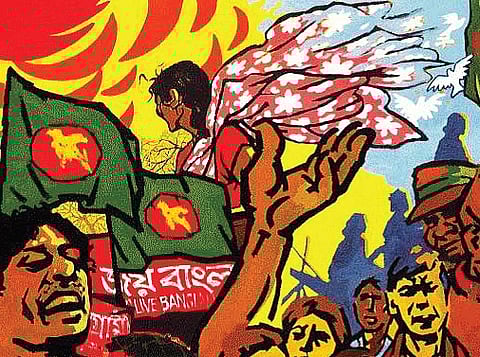

At a time when gruesome violence against those who speak the language of peace, tolerance, and secular ideals in Bangladesh has taken the form of ritualised political practice, cannibalising on its own people, it is important to remember the moment of its freedom struggle.
Nationalist histories are invariably sagas of great men and their romance with the nation. But Selina Hossain’s River of My Blood, a novel set in the decades before and the frantic seasons during the Bangladesh War of Independence in 1971, tells the history of small lives caught in the vortex of grand historical storms. The title is evocative because of the suggestion of violence that all wars unleash, but also because it is a metaphor for birth, of new beginnings. The story begins in a tiny, nondescript village, Haldi, describing the childhood dreams of a spirited girl Boori. Persuaded to marry an old distant relative Gafoor, a father of two sons, Boori does not quit dreaming. Her individuality remains unsuppressed despite her circumscribed life as a householder.

Years into her marriage, Boori becomes obsessed with having a child of her own. After many prayers and desperate years, Boori gives birth to a challenged son. The narrative moves at a quiet pace, following the recognisable patterns of a village girl waiting for an extraordinary future. From an ordinary girl with an unconventional mind, Boori grows up to be a benevolent matriarch, nursing her stepsons into adulthood and always mindful of her own challenged son. Gradually, the fabric of tolerance, a putative peace that weaves the lives of people in small communities begins to fray. News of political unrest, of violence by the Pakistani army, sporadic mutinies against established power structures begin to trickle into the world of Haldi. The grand scheme of the narrative is revealed when Salim, Boori’s older stepson, declares himself a revolutionary fighting for a free Bangladesh. ‘Muktijoddho’ demands sacrifices, demands blood, demands commitment.
The destiny that Boori had been waiting for all her life arrives. It is evident that Boori’s personal life, her aspirations and loss follow the trajectory of the nation slouching to be born. Though unexposed to the strategies of war and political ambitions, Boori rises to the call for freedom. The novel, however, is not an unambiguous tribute to Nationalism.
In the final sequence, the nation demands the ultimate sacrifice from a mother. And Boori delivers.
The novel is originally written in Bengali and wonderfully translated into English by Jackie Kabir. The flavour of the source language is deliberately retained that renders cultural and historical specificity to the story. Baul and the freedom songs punctuate the narrative and move it forward. The songs are left untranslated. After all, among other things, the independence movement of Bangladesh was fought for a language. It is chillingly ironic that now, in contemporary Bangladesh, what is most under threat is the freedom to speak.