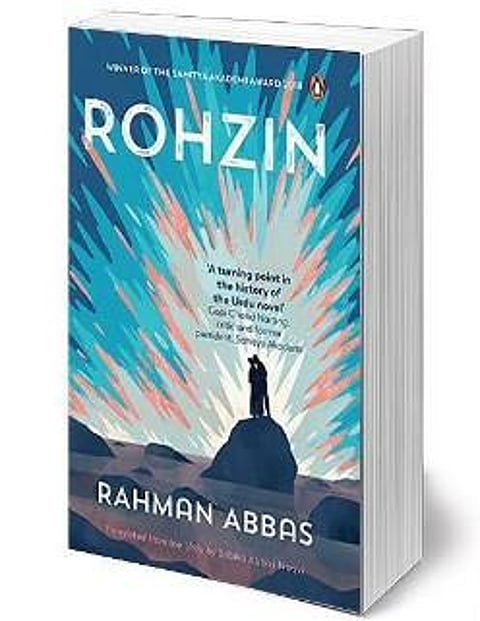

Rohzin is peopled by protagonists. There’s Asrar, the young man who leaves his coastal village to travel to the city of gold that he has seen glittering in the cinema screen. Then there’s Mumba, whose centuries-old serene face is creased into an indecipherable sadness by the turmoil she witnesses in the city of her name.
There are other protagonists.
The city itself, as it lives and breathes–– mostly fetid air––through the novel. Except for the brief visits to the surroundings where Hina, Asrar’s love interest, lives. Much of what we see of Mumbai is through the eyes of Asrar––slums and ditches, rats and stinking hovels, prostitutes’ shanties and smoky beer bars. All of which are transformed into a magical adventure with bright neon lights to show Asrar the difficult path to his future.
The future, like the past, is tragic. History unravels even as the author seeks to unravel the many mysteries of love. Thus the stories of love between his teacher Jamila and Asrar, Hina and Asrar, and Shanti, the prostitute and Asrar, which show the many faces of passion with or without love, are interlinked in inscrutable ways with dire events the city will suffer through––the riots of 1992-1993, bomb blasts, the death in custody of Khwaja Yunus in 2003.
The novel then leaps into the future to predict the terror attack that would shake the city in 2008. The city will survive every assault. But Asrar himself will meet a tragic end along with his love, Hina. A death is foretold as early as the very first lines of the novel.
Love is a recurrent theme that the novel explores. And love it is that makes its protagonists act in uncharacteristic ways. Social themes like migration, prostitution, and religion are some other strands that colour the fabric of this novel. Surrealism and real-life details form an intriguing tapestry. The book is both an escape and a reminder of old wounds and new terrors; it shows us the faces of a city as clearly as it delves into the landscapes of the human psyche.
Not an easy read. It must have been a massive task, given the very different imagery and syntax of Urdu and English, but the fact remains that the novel suffers in translation. Anyone hoping to catch the magic and beauty of the language of the original is bound to be disappointed. The quality of engagement with the language is uneven ––Asrar’s discovery of Mumbai in his early days is mundane, but the passages at Haji Ali where the young lovers meet for the first time are vivid with mood and colour and capture some of the lyricism of first love.
Despite a few setbacks, however, this is an important book, for, among other things, it offers insight, through its many characters, into a Muslim’s view of the events that etched the history of the city. Perhaps that explains the sombre melancholic feeling that pervades parts of the narrative. Read the book as if it were an onion––it reveals its many layers slowly, and like an onion, it packs a sting.