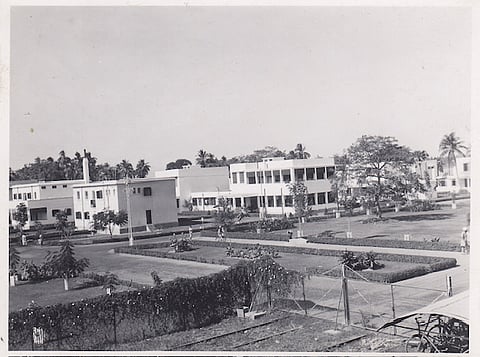

Few brands feel as Indian as Bata. From first-day polished school shoes to the ubiquitous 'Hawai chappals', generations of Indians have grown up wearing the brand. Yet its origins lie thousands of kilometres away in the small Czech town of Zlín, where siblings Tomáš, Antonín and Anna Baťa founded the company after WW 1. It arrived in India in 1931 before establishing the industrial township of Batanagar near Kolkata.
It is this lesser-known story — of a global shoe empire and the township that became home to thousands — that writer Paramita Sen revisits in Batanagar, published by Pan Macmillan India.
For Sen, the story is personal — she spent her childhood in the township, from nursery until Class 10, before her family moved to Bangalore in 1985 and then to California. The idea of writing the book, however, came much later. In 2006, Sen learnt that large parts of Batanagar were set to be demolished as part of a redevelopment project. The news shook her. "I moved in 1985 knowing I could always come back, the reality of an enduring hometown blunting the grief of departure," she writes in the epilogue.

"The news of the demolition affected me deeply. It's like losing your childhood home when it's not there anymore," Sen tells The Morning Standard. “That is where the idea came from. But it took me all these years to decide that it was finally time to write.”
Nearly two decades later, Sen returned to the township in 2024; it "devastated” her. Much of the township had vanished, with empty roads, abandoned homes, and the once-vibrant Bata Club in decay. "Part of me was infuriated. Another part felt helpless because those of us who had lived there and built that community had no say in what happened later." The book, she says, became a way of reclaiming that narrative.
History and memory
Sen alternates between personal recollections—of the Bata Club, annual fishing competitions, school life, Darjee Babu, who stitched dresses for Sen and her sister, and Mastarmoshai, her Bengali tutor—and the history of Bata's rise from Zlín, Tomáš Baťa's industrial vision, the company's arrival in India and the making of one of India's earliest planned industrial townships.
"Initially, I thought it would simply be a memoir. But as I started researching, I realised there was much more material. The township itself had a fascinating history," says Sen. Rather than writing a chronological history, she alternated historical chapters with autobiographical ones. "It was an experiment," she says. "Emotionally, it also helped because I could move between two different planes." Revisiting memories of her father, grandmother and relatives who are no longer alive was often painful, but she says she wanted to "sit with those emotions and capture what living there truly felt like”.
Digging into Bata's history
Condensing over a century of Bata's global history and Batanagar's evolution into just 240 pages required months of research. One of the discoveries that shaped the project was The First Decade of Batanagar, a rare 1945 publication by Jan Baroš. "I went down a rabbit hole," Sen says.
With only three copies of the book available across the United States, Sen had to turn to her younger daughter for help who was studying at Duke University. “I asked if she could arrange an interlibrary loan from Chicago. The book arrived at Duke, and I photocopied the entire thing,” she recalls.
Sen also worked with historian Milan Balaban and connected with former Czech residents of Batanagar, who shared photographs, memories and archival material.
Even then, the book consciously resisted overwhelming readers with historical detail. "I knew I was writing for an Indian readership. People want to know the history, but they don't necessarily want to go into the weeds.”
The Vikram Seth connection
The chapter ‘Of Poets and Playwrights’ brings together writer Vikram Seth and playwright Tom Stoppard through their ties to Bata.
Sen quotes extensively from Seth’s A Suitable Boy, whose fictional town has long been associated with Batanagar, while reflecting on her own admiration for Seth. "There were so many connections I felt with him. I was almost a fangirl. When I realised we shared this connection through Batanagar, it was wonderful. In some ways, it also awakened my own desire to write."
Batanagar is also equally a coming-of-age story, of a young girl growing up in a uniquely cosmopolitan community. Those early years continued to shape her even after she moved from Batanagar to Bengaluru and eventually to the US. "I value community and collaborative living because of Batanagar," Sen says. "It also instilled in me a philosophy of embracing differences.”
The book's final chapter, ‘A Nation Divided’, is a recall of Indira Gandhi's assassination through the eyes of a schoolgirl. School closed unexpectedly by noon after news of the assassination spread. School buses were stopped along the way. Burnt vehicles lined the roads. Fathers walked alongside buses to shield children from possible mob attacks.
"I remember that day vividly," she says. "That was the stepping stone from childhood into adulthood. Until then we had grown up in a protected environment. Everyone came together to protect one another…”
What makes a home?
Undercurrents of migration, belonging and identity run through the book as well. There’s a chapter where Sen talks of losing touch with Bengali literature after leaving Batanagar. A conversation with her daughters after visiting the Venice Biennale offered an unexpected answer.
"I asked them what home meant to them," Sen recalls. "My older daughter simply said, 'Home is where you are, where Dad is. Home is where the people we love are.'" That simple answer has stayed with her. "Even if the physical township disappears, home survives in the people who made it what it was."