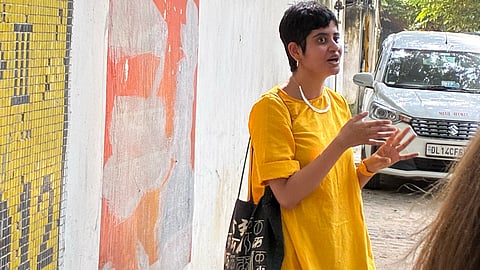

When walking on the streets, how often do we stop to look at the signs around us—the hand-painted boards, fading cinema lettering, or the multilingual shopfronts? In her debut photobook India Street Lettering (Blaft Publications), typeface designer Pooja Saxena documents over 300 signs and street letterforms from cities across India, from Delhi to Bengaluru and Kolkata.
Saxena’s obsession with letters and typefaces began during her days at National Institute of Fashion Technology Delhi. On many metro rides, she found herself scribbling and decoding the LED boards carrying Latin and Devanagari text. “The Latin texts looked nice but to anyone who was observing them with any criticality and interest, much of the Hindi text didn't look as nice.” she says. The observation became the basis for her design and research project, India Street Lettering, which began in 2017 and explored how different Indian scripts occupy the visual space in cities.

Later, while studying typeface design at the University of Reading in the UK, Saxena realised how little Indian scripts were represented in formal typography education despite India’s linguistic diversity. Back in India, she faced another challenge: limited access to typography archives and libraries.
“There was so much interesting design and logos that happened post-Independence—I believe some knowledge of these exists at the institutional libraries, but it's not easy to walk into different educational institutions in our country and use the library. It's like you have the privilege of having connections, which is so different from just being able to get a library card made and just accessing a library,” she notes. Today, she has built parts of her own physical archive, collecting over 500 newspapers from across the world for reference and study.
Building an archive
In 2017, Saxena began India Street Lettering as a digital archive, documenting signboards and lettering from hardware stores, schools, cinemas, churches, residential neighbourhoods and local businesses across Indian cities. Her interest lay in traditional hand-crafted lettering and the visual possibilities created before digital design tools became widespread.
“The sign maker or designer can basically draw the script in the way that they wanted to,” she says. “I was interested in seeing what is possible in these scripts without the limitations of digital technology.” Through the archive, Saxena also wanted to document the unique visual solutions sign painters created while working within material and production constraints.
When talking about Indian Street Lettering, Saxena believes the conversation is often reduced to clichés though there exists many different perspectives in the field. In 2023, she began publishing small-batch zines in Delhi focused on specific lettering styles and categories. The photobook itself took shape after Blaft Publications approached her in 2024.
The book is not intended only for designers. Alongside photographs of signs and storefronts, Saxena also includes interviews with signmakers and maps of neighbourhoods in Delhi, Chennai, Kolkata, and Mumbai that readers can explore through their own “type walks”. “I wanted it for people who actually are in the country,” she says. “I’ll really enjoy it when someone flips through the book and says, ‘Oh my god, this sign. I used to walk past it.’”
The typefaces of Delhi
Delhi occupies a significant place in the book. Familiar landmarks like the wooden sign at Wenger’s in Connaught Place, the lettering of Shri Ram Centre in Mandi House and the Art Deco neon sign of Imperial Cinema in Paharganj all appear in its pages.
Despite having lived in the city for years, Saxena feels she has only scratched the surface of documenting Delhi’s typography. One aspect of Delhi’s typography that particularly interests her is how official buildings and institutions communicate identity through lettering. Colonial-era monuments feature engraved serif lettering, while post-Independence architecture embraced modernist and industrial styles. Saxena points to Shri Ram Centre as an example of how functional lettering became part of the visual language of the newly independent nation.
Delhi’s multicultural population too shapes its signage culture. “In Delhi, you see Hindi, Punjabi, English, Urdu. You don't always see all four, and you see combinations thereof,” she says. In neighbourhoods like Paharganj, she notes, eateries and shops often feature several Indian and foreign scripts to appeal to travellers arriving from the nearby railway station. Languages like Korean and Hebrew also appear on some signboards catering to tourists and international visitors.
But Delhi is rapidly changing, which means older signs disappear constantly. Saxena recalls feeling emotional when Paras Cinema in Nehru Place replaced its original signage during redevelopment. “I used to really love that sign,” she says. She also points to older wayfinding signs in Lodhi Colony and traditional shop signs in areas like Kashmiri Gate being replaced by printed flex boards.
Reading the city differently
Saxena hopes to create a growing archive of India’s visual culture while encouraging people to notice the typography around them more closely. She regularly conducts type walks, guiding groups through city streets and decoding the stories hidden within signs and lettering.
“These are ways for me to start a conversation about something that I care about,” she says. “It just makes you more curious about what the world around you is like and expands our view of how we see the city—with a fresh point of view.”
Now, as she continues organising photographs from older archives and recent travels, Saxena is preparing for future documentation journeys to places like Bhubaneshwar, South Goa, Coimbatore and Meerut, along with more zines and updates to her online archive, while also planning a more thorough exploration of Delhi’s streets in search of the city’s disappearing signs.