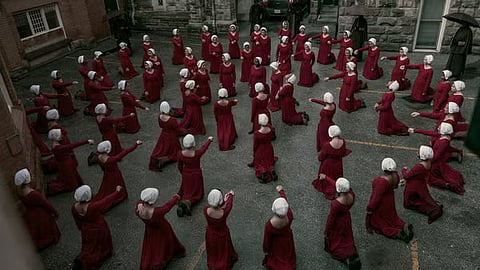

'Better never means better for everyone... It always means worse, for some.’ In Margaret Atwood’s 1985 novel The Handmaid’s Tale, the commander offers this explanation of the world he inhabits. Set in the Republic of Gilead, a totalitarian regime that emerges in a near-future United States, the novel imagines a society where declining birth rates and religious extremism become justifications for controlling women’s bodies. Women lose their jobs, money, names, and freedom. Those who can bear children are forced into reproductive servitude, assigned to powerful men and their wives.

Through the eyes of Offred, the protagonist who is the handmaid, the author examines how an authoritarian government can gradually strip people of their rights while presenting oppression as social order. The unsettling part is how much of Gilead draws from historical events. The author has explained that she included nothing in the novel without a precedent somewhere in history or another country.
As the Canadian author celebrates her birthday today, we revisit the novel through the imagination of women who have read her work. CE asked them what makes Atwood’s dystopia so unsettling and what kind of world they would build in its place.
When fiction feels familiar
For Nithya Mahesh, founder of Mintelligent India, the novel’s frightening quality lies in its proximity to reality. “Even though Margaret has written about a dystopian world, every issue she has referred to is something that has actually happened at some point of time in human history,” she says. Reading the novel gave her goosebumps — she wonders what might happen if people in power continue to function without empathy. “What is the guarantee that the dystopian world Margaret conceptualised, won’t actually become a reality? That thought is unnerving.”
The ordinary beginnings of Gilead disturbs the readers considering how relatable they are. Manjima, a corporate professional and reader, recalls the suspension of the Constitution, women’s bank accounts being frozen, their jobs disappearing and their money being transferred to male relatives. “I kept underlining lines and scribbling notes like ‘nothing dystopian about that,’ because nice girls were told to just ignore the minor antics of men. It sounds like dinner-table talk even today, and that’s what’s frightening,” she says.
Manjima is particularly interested in Aunt Lydia, who trains the handmaids in the first novel. The sequel, The Testaments, reveals more of Lydia’s life before Gilead and the circumstances that shaped her position within the regime. She finds this transformation compelling because it offers a glimpse into power dynamics within oppressive systems.
She also points to the opening of The Testaments as an example of Atwood’s ability to unsettle readers instantly. ‘Only dead people are allowed to have statues, but I have been given one while still alive. Already I am petrified’, reads its first line.
For Manjima, Atwood’s lasting strength lies in her treatment of power and control, and the ways ordinary people respond to both. Her sharp humour, she observes, can momentarily make readers forget the horror of the world they are reading about. Imagining another world The readers’ imagined futures offer different ways of thinking about power. Nithya’s ideal society would place women in positions of leadership. She believes empathy at the top could influence equality, work-life balance, equal pay, shared workloads and environmental responsibility. “This group of leaders will view people as humans first before segregating them based on gender, skin colour, class, caste, wealth, etc. That’s all the world needs, humanity before anything else,” she says.
Sarah Rahaman Shaikh, who is pursuing an MA in English literature at Calcutta University and works as an author and content creator, imagines a matriarchal world where pregnancy is seen as a symbol of power. She describes, “A woman manages everything outside house, and husbands take care of the house. The men have no say in anything, and are vulnerable to sexual objectification and abuse. Thus, the dystopia begins when men retaliate against their submissive roles. The setting would be the 1800s and more like a switch of feminist waves. The moral of my story would be gender fluidity and equality, providing a feminist moral of how women are treated, and even in 2026, they struggle with prejudices.”
Meanwhile, Manjima’s world with no villain becomes a relief to humankind. She explains, “Machines and their artificial hands, bodies, and minds take over the jobs one by one, until there’s nothing left to do. Currency does not exist anymore because there’s nothing to exchange. You wake up, food arrives on time, you are bathed, you mate until you’re tired, you doze off, and repeat. Even learning stops mattering because you don’t need to study to get anywhere.” She describes her world as bliss. “Relationships improve because people finally have time for each other. Then something starts to curdle. Without work, there’s nothing to measure yourself against, and “what do you do?” stops being a question. People’s identities and their drive to prove themselves — all vanish. They start missing the things they once complained about.” Here, nobody banned anything but the scariest part is people almost gave away their freedom and self-sufficiency too quickly.
Reading against censorship: The novel’s continued relevance has also made it a target of censorship. The American Library Association has documented challenges to The Handmaid’s Tale, citing profanity and what objectors described as vulgarity and sexual overtones. PEN America’s 2025-26 reporting also identifies it among titles repeatedly banned in US school districts. History offers a stark reminder of why censorship deserves scrutiny. In May 1933, pro-Nazi university students burned tens of thousands of books across German cities, targeting works by Jewish writers, pacifists, and left-wing thinkers. The Nazi regime supported these book burnings and went on to suppress newspapers and criminalise criticism of the government. Book bans alone do not establish that a government is fascist, but censorship has long served authoritarian efforts to control public debate. The American Library Association’s Freedom to Read Statement argues that access to a diversity of ideas, including unpopular and unconventional ones, is essential to democracy. Perhaps one way to celebrate Atwood’s birthday is to take her fiction beyond the page. Reading the books that authorities seek to restrict, questioning the systems they expose, and building our own imagined futures are all ways of engaging with an author’s creativity. After all, the women reading Gilead today are also imagining worlds that need not resemble it.