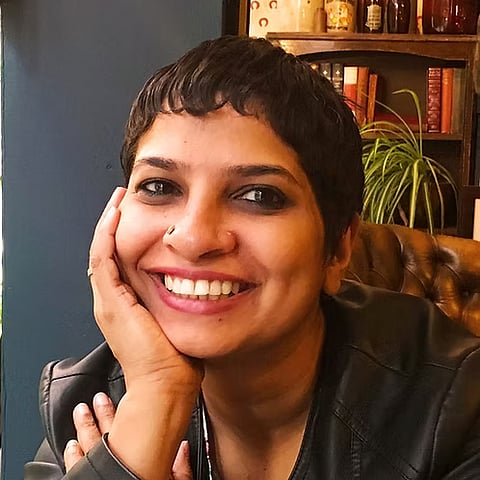

“You can repeal the law, you can't repeal prejudice, you can't repeal narrow-mindedness, you can't repeal bigotry,” says author Arathi Menon, speaking about her latest book, Da.
Menon’s third book is a coming-of-age story centred on 13-year-old Ved and his adoptive father and maternal uncle, Da. Set in 2013, when Section 377 of the Indian Penal Code criminalised consensual same-sex relationships, the novel follows Ved as he navigates adolescence and the growing realisation that his beloved Da is gay.
Choosing 2013 for the setting was deliberate. While the Supreme Court read down Section 377 in 2018, Menon believes the attitudes that sustained the law have been harder to erase. “Though it's set in 2013, it feels very current,” she says. “That was important for me — to take you along Ved's journey in that slice of time and understand what Da was going through.”

Menon remembers being a politically engaged college student in the early 2000s, attending protests calling for the repeal of Section 377. She also recalls an incident in which a friend was harassed by a police officer after being caught kissing another man in public.
“He wasn't put in jail, but he couldn't talk about the harassment in a police station because that cop was like, ‘It's illegal’. What are you going to speak about?” she recalls. “I remember we were so young and so helpless. We were just so angry.”
Years later, that anger found its way into Da. But Menon did not want to write only about the law or queer rights. She wanted to show what prejudice looks like inside an ordinary household.
Da cooks Ved his favourite food, helps him navigate school and his first girlfriend, and gives him the freedom to be himself. Their lives are filled with the everyday routines of a middle-class family — food, friends, school and domestic squabbles — even as Da’s sexuality makes their existence increasingly precarious.
“When you think of families, it's a very heteronormative gaze, and I really wanted to go away from that and show that this is a normal family,” says Menon. “This maybe isn't what some people are used to, but that doesn't take away from parental love. It doesn't take away from a father making his son his favourite biryani.”
Finding Ved’s Voice
Menon tells the story through Ved’s eyes, which was one of the book’s biggest challenges. She experimented with several versions, including writing in the third person and from Da’s perspective, before finding a voice that felt right. “It was hard, but it was also a lot of fun. When I came to Ved's voice, it felt right because it had a lightness to approach this heavy topic,” she says.
Writing from the perspective of a character whose experiences were so different from her own also made her conscious of the need to make Ved’s voice authentic. “I am not a 13-year-old boy, neither am I a gay man, and I didn't want to be a heterosexual person making a mishmash of a narrative,” she says. “Because even though Ved isn't gay, or we don't know yet, maybe later in his life, it is his experience, and that has to be authentic.”
To inhabit the mind of a 13-year-old, Menon returned to books that had captured adolescence in distinctive ways, including Tobias Wolff’s This Boy’s Life and J.D. Salinger’s The Catcher in the Rye. She also read writers such as Alan Hollinghurst and Salman Rushdie, as well as the poetry of Charles Simic.
Ved’s innocence became central to the narrative. He wonders whether his uncle’s sexuality could somehow be hereditary, takes magazine quizzes to determine whether he is gay, and simultaneously tries to make sense of his own emerging sexuality, friendships and first love.
From rejection to publication
The book took almost five years and several drafts to complete. Finishing the novel was only the beginning of another challenge: finding a publisher willing to take it on. Several literary agents in the UK rejected the manuscript, telling her they loved the writing but did not think the story was “relevant enough”.
“An agent wrote to me saying, ‘We don't know how to sell this book,’” she says.
Menon persisted, eventually finding a home with independent UK publisher Fly on the Wall Press, before Pan Macmillan India picked up the book. “I was very sure I'm not going to give up on that. If I give up on that, who else will champion it? Otherwise, it's just going to be a Word document on my laptop,” she says.
For Menon, the purpose of Da ultimately lies in making prejudice appear as illogical as it is. Menon recalls her mother reading the novel and remaining quiet for two days before asking, “What did Da do wrong? He only wanted to love someone.”
For Menon, that question captures what Da is trying to do: make readers look at a life they may have been taught to judge, and simply see a family. “I want a reader to say, ‘Why are they penalising him? He hasn't done anything wrong. He's a great father, he's a great human.”