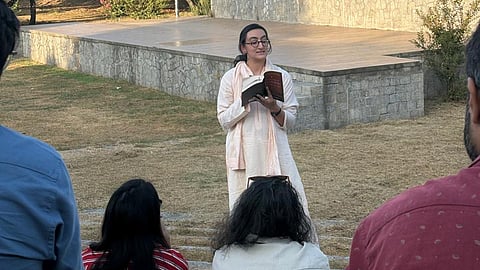

From devotional verses and folk songs to short stories, radio plays, poetry, ghazals, flash fiction, songs, and excerpts from novels and plays. The Big Book of Kashmiri Literature brings together centuries of writing from Kashmir in a single volume. Edited by Onaiza Drabu, the anthology features around 120 pieces translated from Kashmiri into English.
Kashmiri is Drabu’s mother tongue, which she understood from an early age, but says she had little exposure to its literature. It was only around 2013-14 that she began reading Kashmiri literature and studying its literary tradition seriously. Drabu is a business anthropologist who also runs Daakvaak, a digital publication focused on South Asian literature and art. Her first book, The Legend of Himal and Nagrai: Greatest Kashmiri Folk Tales, was a collection of Kashmiri folklore, published in 2019. For this project, she first began translating Kashmiri into English. So when Penguin approached her to put together an anthology of Kashmiri literature as part of its series on regional literatures, she took up the opportunity.
Drabu says she wanted the anthology to represent “all the genres in some way or the other” as Kashmiri has a rich oral tradition, with much of its literature existing through songs and performances, and not only in the books. The anthology therefore treats Kashmiri folk and oral traditions as a significant part of literary history rather than placing them outside it.
Stories of home
The process of putting the anthology together took several years. The first year and a half of the process was largely spent reading, after which she began putting together an initial list of works she wanted to include in the book. She then began speaking to translators, which helped her discover works she had not initially considered.
The anthology features works that explore themes of place, memory, loss, exile, changing social relationships and the experience of living through a changing Kashmir. The idea of abandoned homes and the memories attached to them appears repeatedly in the book. In one section, Moti Lal Saqi’s poem about an abandoned house is placed beside a poem by younger poet Nighat Sahiba, who grew up in the 1990s and saw the abandoned homes of Kashmiri Pandits, asking whose houses they were.
Nature, too, is an important presence in the book — it is the backdrop to many of the poems, songs and stories. But, as Drabu points out, it does not necessarily mean that the works are just about beauty or landscape. A river, a tree or spring may instead become a way of speaking about exile, ageing, debt, loss or a changing society.
In one poem, a mulberry tree becomes witness to the generations of a family that have left home, while in another, the beauty of spring stands in contrast to an artisan who is trapped by debt and unable to enjoy it. This close relationship with place runs through Kashmiri literature even when the writing enters fictional, fantastical or seemingly placeless worlds.
In ‘Shraz’ by Hriday Kaul Bharati, the titular character comes from Kashmiri folklore. While the story itself is not tied to a specific place, the use of a figure so deeply rooted in Kashmiri mythology makes its connection to Kashmir unmistakable.
An interesting section is ‘Waandar Raj’, or ‘The Reign of Monkeys’, from a time when print culture, plays, short stories and sonnets discussed political issues. According to the introduction to the section, it moves from peasant struggles and the realities of political and social change to growing disillusionment, ending with the trauma and dispossession of the late-20th-century “exodus” of the Pandits.
Overall, the anthology also reveals how Kashmiri literature often responds directly to the society around it. Drabu observes that many short stories, particularly those from the 20th century, have a strong didactic quality. Rather than following a conventional plot with a clear resolution, they function as sharp observations or anecdotes intended to make the reader think.

An evolving language
Beyond the anthology, Drabu sees Kashmiri literature as a living and active tradition. While its publishing space remains small and many writers self-publish, she notes that literary communities continue to meet, write, translate and critique each other's work in the region.
She points to fiction writers who meet regularly for workshops, literary associations that organise conferences and discussions, and the work of cultural institutions in documenting folk songs, lullabies and traditional forms of theatre such as bhand pather.
The new generation is becoming more interested in Kashmiri literature and translation, she says. Digital platforms and social media have made it easier for young writers and readers to publish, share poetry and form reading communities “without depending entirely on traditional publishing”.
The author also notes that the language itself is evolving. Kashmiri has historically absorbed words and influences from languages including Persian, Sanskrit, Arabic, and Punjabi. In recent decades, Hindi, Urdu and English words have increasingly entered everyday Kashmiri, sometimes replacing older, rooted Kashmiri words, she adds.
“Language attrition is evident in urban areas of Kashmir. In rural areas, however, you will find people who are pretty much monolingual in Kashmiri,” she says.
For Drabu, translation can play an important role in ensuring that Kashmiri literature reaches readers beyond the region and encourages more people to engage with the language. But she believes this will require greater institutional support, including grants, and more commissions for translators.