
“Where once was greenery and beauty springing blithely,
Where once my grandma basked her grey tresses sprightly.”
This couplet from poet Arun Sarma’s work, Kabyanurag, on the book’s back cover, translated from the original Assamese, best encapsulates what Akriti is all about. A nostalgic look back at the way of life that was, and an attempt to preserve it for posterity.
As in everywhere across India, beautiful old houses are increasingly giving way to bold (and most times ugly) new high-rises. This is why this coffee table book, compiled by craft revivalist Nandinee Kalita and her team, becomes all the more important. Some 160 pages of 200 photographs of 100 homes, each with detailed text, make it a veritable visual delight. And a prized collectors’ item. Not just for those whose memories are associated with them, but also for students, practitioners, and even lovers of architecture.

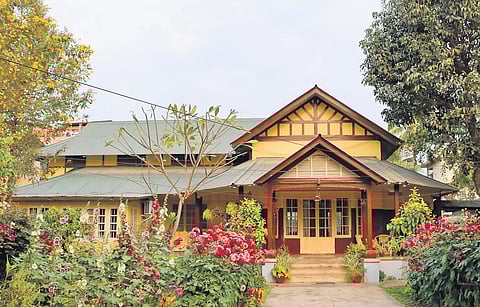
First, what exactly is an Assam-type house? It’s primarily a single-storey structure, with a few exceptions, built on vertical, load-bearing timber frames in the chang ghar (stilts) or two-storied style. The plinth of the house is raised above the ground level to avoid marshy overgrowth, run-off during rains and also to keep stray animals away.
Another distinctive feature are the eaves, barge and fascia boards, which serve multiple functions. The boards that are fixed to the projecting gable to give it additional strength, also serve as protections to the exposed timber endings of the roof such as joists and purlins, as well as protect it from high-speed winds. Above all, these ornate embellishments also define the unique signature of the houses. And the stature of the owners.
Just as these homes were a labour of love for their builders, this book has been an equally gratifying experience for Kalita (also the aforementioned poet’s daughter), who conceptualised and coordinated the project with a group of enthusiasts comprising educators, writers, researchers, photographers and painters. (Way too many to name as that would take up the entire column space here). What held them together was the common goal that this was most likely their last chance to document these fascinating homes before they disappeared.
For they are vanishing fast, as Kalita laments, giving way to multitudes of multi-storeyed apartments. Those that have survived are a testament to their structural durability, making the best use of vernacular technology and local materials. Once the pride of the state, today they stand with a wistful longing for their past glory.
All is not lost though, Kalita hastens to add. Many still continue to serve their original purpose as gracious family homes, offices, schools, libraries and residences for government officials. Some have also been successfully converted into heritage hotels and clubs. The book brings all kinds to the fore—the struggling, the striving and the thriving.
It took a good two years to put together, recalls Kalita. As the team set about identifying and locating the homes, many friends and family who got to know about the project came forward with information. The humongous task was validating their information and documenting their history. “But the best was that nobody refused to be part of this,” she says, adding, “We walked into unknown houses and asked permission to photograph, to which they readily agreed. In fact, a lot of friendships and bonding happened over lunches and dinners.”
While there has been a book some years earlier on tea plantation bungalows specifically, this one is unique in the sense that it captures a much wider spectrum ranging from simple Assamese family homes to the elite bungalows of business and cultural icons, as well as public institutions. Less of a book, actually, and more of a passion project of the people, by the people, for the people.
“The entire exercise was a journey of discovery, of understanding the passion, resilience, history and lifestyle of a bygone era. While we traversed the hills and vales of Assam, quaint little towns and villages, clocking more than 7,000 km identifying houses and interviewing homeowners, the sole regret is that many still could not be discovered and documented,” says Kalita.
So, is Akriti 2 in the offing? Well, watch this space.