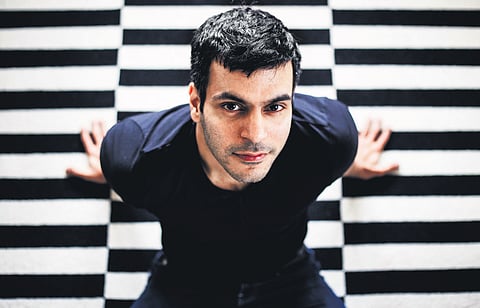

It’s a smart man who intuitively whips up delicious cocktails when handed a bunch of ingredients. And, interior designer Ravi Vazirani is definitely a very smart man. Very talented too, going by the gorgeous spaces he has created for several luxury retailers, restaurateurs and celebrities such as filmmaker Karan Johar and fashion impresario Rhea Kapoor. Best of all: the creative brilliance comes naturally. Vazirani didn’t study design or intend to be an interior designer. He did his Master’s in Marketing from a university in Australia and was meant to pursue a career in advertising. But life designed a different plan for him. (Ironically, his sister studied interior design, but she does not practise it). Here, he talks about his work and his penchant for coffee tables.
You say your creations are all byproducts of your design work, created in answer to a client need. But how is it that so many tables find their way to your website?
My products are a result of my needs, which are sometimes for personal use and often for design projects. I started my career as a stylist, art-directing shoots for publications; then progressed to designing spaces. Hence, making products comes as a natural extension of my design journey. I enjoy designing tables, which is why you see a lot of them.
Do you find tables more interesting than, say, beds or chairs?
It’s all fascinating. However, the approach to designing different products varies. For chairs, you have to understand ergonomics and work with upholsterers, etc. Given that I work in Bombay and don’t necessarily have the kind of space I’d like to, I end up designing smaller pieces, mostly tables and lamps. Having said that, we have designed larger pieces, but they are site-specific and I don’t particularly see them as an extension of the design language under our product portfolio.

How many kinds of tables do you sell at the moment?
I wish I knew. I have lost count. My team has a new table for me to try every other week.
Many of the tables look like variants of each other. Are they?
I am a creature of habit. I can eat the same meal every day for months. I buy the same black T-shirt in bulk if I like the fit, and I’ll buy the same shoes in every conceivable colour if I like them. I design the way I consume. They are variations of the same design but in different materials and proportions. The way I see it, a common soul in different bodies.
Can you tell us the idea behind your Stubby, Cocktail, Scoop and Naga tables?
The Stubby gets its name from its proportions. It’s chubby and short, hence, Stubby. It’s a simple play on geometrics that I really enjoy. As the name suggests, the Cocktail is a wonderful drinks table. I am an aesthete and a collector. I like to display everything, which usually means you won’t find a single surface where I haven’t displayed something. The cocktail tables come in handy then. They are easy to move and great for placing your drinks, eating, or even displaying some flowers. The Scoop is one of the first tables we designed in our collection in 2020. The idea was to scoop out a piece of rock. Well, the pandemic didn’t really allow for that experimentation, so we modelled it in clay and cast it. The name stayed.
The Naga is inspired by the Naga daybeds that are simply beautiful. I wanted one for a very long time. Back then, as a 20-year-old design enthusiast, I couldn’t afford one. When I could finally afford one, I didn’t want one because of how common they had become. So, I decided to experiment and make it in paper pulp. It’s my own take on the classic Naga table, a homage to those beautiful tables.
What materials do you like to work with?
We work with a variety of materials: fibreglass, stone, stoneware and paper pulp. India is a treasure trove for materials.
I work with whatever I can get my hands on. I want to learn, engage and experiment.
Do you have a favourite piece among your creations?
The paper pulp pieces are truly a joy. The ceramic pieces take a lot of effort, so they are special. The cast pieces celebrate an age-old technique. You get the drift. I like them all. I live with them all.
How would you describe your design language?
My design language is soulful. I strive to infuse each piece with a sense of depth and emotion, creating objects that resonate on a personal level. My work often combines simplicity with thoughtful details, focusing on the harmony between form and function. I believe that good design should not only be visually appealing, but also evoke a sense of connection and comfort. My approach is intuitive, often inspired by natural forms and traditional craftsmanship, yet always seeking to push boundaries and explore new materials and techniques. In essence, my design language is about creating pieces that tell a story and enrich the spaces they inhabit.
Does Indian craftsmanship interest you, and do you use it in your work?
Yes. It would be foolish not to make use of the wonderful resources we have. We recently did a version of our Cocktail table with Bidri work and a version of our Stubby table with Taarkashi work. Our paper pulp tables are made in Kashmir by expert craftsmen. Our Longpi table is made in Manipur. Our ridged ceramic lamp is handmade by ceramicists in Maharashtra. I incorporate it into my work by collaborating with skilled artisans and integrating traditional techniques with contemporary design.