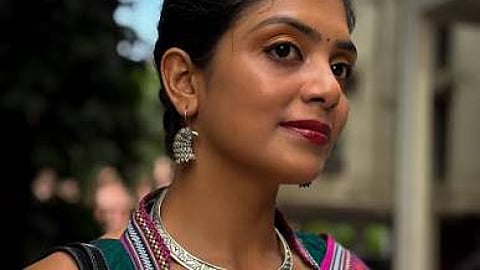

As the aroma of incense sticks takes over the living room, diyas line up our entrance, ornamental lights adorn the balcony, ghee sweets get passed around, amma’s treasured saris come out, appa’s silk veshtis are carefully unpacked, and the home rings with laughter and chatter, you know the season of festivals is here.
These days, festivals are not just about rituals and decorating homes and idols; they are also a chance to make bold fashion choices and set new style statements.
Starting with makeup, a major Gen Z trend is quirky bindis, with three different kinds stacked on the forehead, or quirky details drawn with eyeliner. Designs like the moon, star, and fish are also being drawn on the forehead and even the chin. Shriya Srivatsan, founder of Chennai-based fashion label Anaira, notes that while soft glam and natural makeup looks will always have their place, festivals are the perfect excuse to experiment a little. Coloured eyeliner, blue or green kajal, shimmery eyeshadow or even a bold lip can make a look much more interesting. “Even adding one pop of colour to an otherwise simple look can make a difference. Makeup should be fun,” she says.
The outfit and its colour set the tone for the entire look. And when it comes to Navaratri dressing, there is no dearth of options to choose from — traditional silk saris, detailed salwar suits, contemporary fusion wear, or experimental silhouettes. Shriya says, “People are having a lot more fun with traditional wear now — A sari with a corset blouse, or pair a lehenga with a shirt, you don’t have to stick to the usual way of wearing something anymore.”
Swachchatoya Roy, who closely follows fashion, notes that a lot of co-ords, Indo-Western pre-draped sari, shararas, and fusion wear will be spotted this season. “With Gen Z adopting the sari culture, a lot of silk, silk blend, modal silk, cotton, muslin, handloom saris in classic drape or open pallu style, halter neck blouses with a statement back embroidery, retro-style puffed sleeves, even western wear with a Bengali touch like Jamdani co-ord sets and dresses are expected to make the rounds,” she says.

In South Indian tradition, a fabric that has maintained its icon status for centuries and has entered a new wave of trends is Madras checks. “It’s lovely to see Madras checks making such a comeback. It’s a fabric we’ve known for so long, but seeing people embrace it again and style it in newer ways is so exciting. We’re realising that we don’t always need to look outside our own culture for inspiration,” notes Shriya. She expects Kanjivaram silk, Chettinad cotton, and Sungudi, along with traditional weaving and dyeing art, to resurge.
If fabric and design form the foundation of an outfit, embellishments are what elevate it. “For Navaratri, people will always love a little sparkle, whether it’s zari, sequins, mirror work, or embroidery. But I don’t think every outfit needs to be heavily embellished to look festive. Sometimes, a beautiful fabric, an interesting blouse, or even a statement border can do the job,” says Shriya, citing that for fabrics like organza or tissue that have multiple shades, one needn’t plan much.
Prints like ajrak, ikkat, bandhani, and mirror work, traditionally covering the chaniya choli, are now limited to certain areas as embellishment rather than the focus, continuing the trend of subtle styles, shares fashion designer Bassam Osman. “There was a time when people were doing mirror work all over, but now, people prefer smaller mirrors just to make it a little dressy. With traditional crafts like bandhani, too, it would be in red or yellow, but we are increasingly seeing them in greens, greys, and even blue.”
People are also looking beyond the traditional reds and whites this season at Garba events, Durga Pujo, and Golu. “Apart from the usual festive colours, deeper shades like wine, emerald green, and burgundy will look beautiful. In South India, gold is an important part of festive dressing. So gold accents paired with unexpected colours can be a beautiful alternative,” Shriya suggests. For Durga Pujo, additional colours such as shades of pink, indigo blue, and brown will be seen. “Durga Pujo screams bright, whimsical colours, so a lot of shades in the red and yellow family will be spotted,” adds Swachchatoya. Chaniya cholis are also moving beyond the red, yellow, green, and orange to a mixing and matching blouse, skirt, and dupatta in different colours, usually combining softer colours like whites and lilac or maroon, and subtle pista or sage greens.
Accessories bring the entire look together. From traditional temple jewellery to contemporary statement pieces, the right additions can hold your style without overwhelming it. “In South India, traditional gold jewellery, temple jewellery, and jhumkas are a big part of festive dressing, and they’re not going anywhere. At the same time, statement silver jewellery and more contemporary earrings can look beautiful with simpler outfits. If you’re wearing a very detailed sari, keep the jewellery minimal. If your outfit is simpler, you can have a little more fun with statement pieces,” suggests Shriya.
Swachchatoya adds, “A lot of stacked bangles — gold, gold-plated, oxidised, clay — big jhumkas, earcuffs, layered necklaces and traditional chokers will be popular this year.”
For footwear, a standout accessory this year among traditional mojaris and sandals is the bedazzled sneakers.
Men’s festive fashion, too, has a lot of room for experimentation. Beyond the usual kurta and pyjama, Shriya suggests that men play with colours, textures, interesting cuts, and accessories. “Even a well-styled kurta with a veshti can look incredibly elegant. You could also experiment with contemporary kurta sets, adding a twist of sari/dupatta styled into your outfit, layering jewellery to make the outfit more personal,” she says.
As Navaratri brings with it a season of celebration, it also comes with reasons to experiment with personal style. Whether it is a sari with a blazer, a statement piece of heirloom jewellery, or a makeup look that complements the outfit and skin texture, the possibilities are endless. After all, festive dressing is not just about following trends. It is about celebrating individuality, creating memories, and finding joy in dressing up.
There are so many flavours of style in the LGBTQIA+ community. It’s important to remember to have fun while dressing yourself up. Wear what brings you joy as a queer person. Wear what others may see as extra. We are not meant to blend in. We are not made to conform. We are going to stand out and we shall do that in style.
Ashwin Thiyagarajan, fashion designer