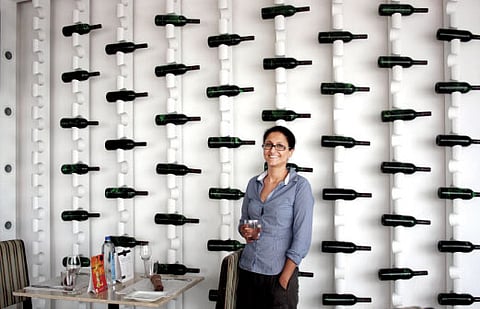

She made her mark with an exemplary demo of her cooking skills on Foodistan, an India-Pakistan cook off on television, and went on to be the first runner-up. Khurshid Amina Agha, lovingly known as Poppy Agha, has her roots in Karachi and heart in New Delhi where she plans to open up her very first restaurant. She also teaches cooking to her students at Poppy’s Culinary Institute back in Karachi and hosts a TV show there. While in Delhi, Poppy traces the odds and similarities between street food served here, and that which she gorges on back home.
“To begin with, unlike India, kebabs and tikkas are not considered street foods in my country. Karachi street food is more like Mumbai, and Lahore street food is more like what one gets to sample in North India,” says Poppy. “If I take an overall view, chaat in India is far better in terms of the concept, the masalas and the variety. Then, there are foods that you get in Delhi which are unheard of in Pakistan, and vice versa. Other than that, one gets almost everything across the border, but in a slightly varied version. That happens due to the vast expanse of the two countries, as it happens within India also. Pani puri in Mumbai is way different from golgappas in Delhi. So there,” she explains.
“In Pakistan the chilli quotient is much more higher than India. We like our food very, very spiced up, especially so in Karachi. In Lahore and Delhi, the food spares the tongue and the stomach as far the spices are concerned,” the chef tells. “Pakodas, samosas and jalebis are the common street foods in India and Pakistan. Delhi food is more like Lahore, where you get more of heavy duty, makhani-based stuff. Bhelpuri and golgappas are almost same in Pakistan and India, but eating at hawkers is not that common in Pakistan,” Poppy reveals.
So what does she love about Indian food? “Rajma-chawal, that I love to eat when in Delhi, is not made in Pakistan,” Poppy says. “Hing or asafoetida is unheard of. I have never encountered raj kachoris in Pakistan. The spherical kachoris are much better in India than there. Also, in Karachi, people like to order in more than eating out. So takeaways are a big hit,” she goes on to explain about delicacies she misses when she is not in India. “In India there are many varieties of kulfi like phalsa, aam panna, jamun whereas in Pakistan we have the traditional kulfi with nuts, though mango kulfi is gaining popularity,” Poppy observes.
“Exposure to different cuisines is picking up in Pakistan but traditional foods of Pakistan are still quite popular. Those who are well-travelled are the ones who have the real exposure to cuisines from across the globe. The homemaker on the other hands gets to brush up their cooking skills through channels on Pakistan television that are devoted to food,” she says after pondering a bit.
About the foods that are popular in Pakistan she says, “We love our chana roast off the hawker, and the amrood/guava sprinkled with chilli is a popular snack. The fresh masala fry is French fries spiced up with a masala and is a hit in my country. Bun kebab is another hit.” Talking of bun kebab, Poppy explains “It is mutton kebab dipped in egg and placed between a bun, topped with laccha onions and a coriander, mint chutney. Dhaga kebabs are quite famous too. In Delhi, I discovered they are called the Sutli kebabs. Chicken tikkas are a rage in Pakistan and all tikkas and kebabs are served with naan bread. In Peshawar, chapli kebabs are much loved. Partition also left its mark on the Pakistan’s street food, especially Karachi, where people from Hyderabad, Mumbai and Lucknow came and settled. So Karachi street food features something called Student Biryani, which I am told is similar to the biryani of Mumbai.”
“In Karachi, I order thrice a week and love to order from a chain called BBQ Tonight. I also love the nihari from Sabri. In Delhi, I love to head to Al Kauser for the kakori kebabs and Bengali Market for the lip smacking chaats. And I always make it a point to take back a box of Kaju Katli for my grandmom as we don’t get it there, at least I am yet to come across this irresistible sweet in Pakistan,” she says, ending on a sweet note.