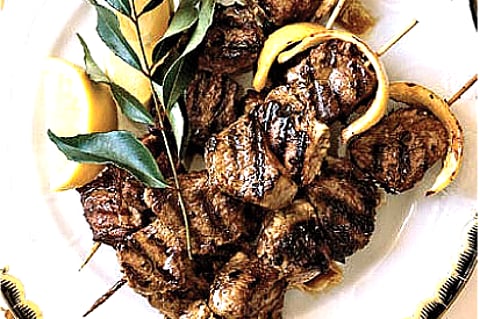

Rajasthan, a princely desert state, reminds me of the numerous kings and heroes of the past, brave and beautiful queens and larger than life palaces and their opulence. I have always been fascinated with royalty, their unique lifestyle and of course mostly with the gourmet cuisine that came with it. This column is a tribute to many unsung or forgotten royal chefs who must have contributed to the royal dining and have made impact on the culinary styles and taste. Lately, while shooting for a travel show for a television channel, I chose to showcase Rajasthani cuisine because I feel that this rich cuisine deserves to be celebrated.
Rajasthani cooking is influenced by both the warrior lifestyles of the natives and the availability of local raw materials in the arid region. Tendency was to cook food that could be preserved for several days. Scarcity of water and fresh green vegetables effected the cuisine considerably. Most popular dishes from the region are snacks like Bikaneri Bhujia, Mirchi Bada and Pyaaj Kachori. Locals relish Bajre ki Roti (millet bread) with Lahsun ki Chutney, Gatte ki Sabzi, Lal Mass, Sangar ki Sabzi etc. The list of desserts is long; my favorites are Alwar ka Mawa, Malpuas from Pushkar and Rassgullas from Bikaner. Marwari cuisine is famous for its vegetarian food, typically served in thaali.
The Rajputs, for example, made sulé or smoked kababs long before the Mughal invasion. Hunting was a popular sport of the Maharajas and game meat was a favourite. It was often cooked over an open fire in the forests. All the meat was not consumed on the same day, and was pickled to preserve it for the next day.
Rajasthan, particularly the area of Palanpur, is renowned for its kababs, as the Nawabs of Palanpur were of Afghan descent and introduced kabab and pulao to the state.
I think I have dramatised the cuisine and by now as always your mouth must be watering to have the thaali or the Rajasthani Boti Kababs. I am sharing one of my recipes from my forthcoming book the Kabab Trail: The Kingdoms of Kababs, and I am sure you all are going to love this delicious royal recipe.
Rajasthani Boti Kabab
INGREDIENTS
Lamb, boneless—250 gms
First marinade
● Raw papaya paste—1 tbsp
● Ginger-garlic paste—1 tbsp
● White vinegar—1 tsp
● Red chilli powder—½ tsp
● Salt—½ tsp
Second marinade
● Yogurt, hung, whisked— 2 tbsp
● Ginger-garlic paste—1 tsp
● Garam masala powder— 1/3 tsp
● Cardamom powder- 1/3 tsp
● Salt—½ tsp
● Fenugreek leaves, dried, powdered—1/3 tsp
● Cinnamon powder—1/3 tsp
● Oil—2 tsp
To cook the kababs
● Ghee—for basting
● Garnish-chopped coriander- 1 tsp
Wash the meat, trim it and cut it into 2” cubes. Pat dry.
FIRST MARINATION
Combine all the ingredients for the first marinade in a bowl and whisk till well blended. Add the meat and mix well, to ensure that it is completely coated with the marinade. Cover and set aside to marinate in the refrigerator for about one hour.
SECOND MARINATION
Whisk the yogurt in a bowl with the remaining ingredients for the second marinade. Squeeze the marinated meat with your hands to remove excess moisture. Add it to the bowl and mix well to ensure that the pieces are well coated with the second marinade. Cover and set aside to marinate in the refrigerator for four-five hours.
TO COOK THE KABABS
Remove the meat from the refrigerator and bring it to room temperature. Thread the meat on to long, thin metal skewers, 1” apart. Grill the kababs under a very hot gas or electric grill for 8-10 minutes. Baste with ghee, turn the skewers and grill again for another seven-eight minutes.
TO SERVE
Slip the kababs off the skewers on to a serving platter. Garnish with chopped coriander and serve with Lahsun-Mirch (garlic and chilli) Chutney.
LAHSUN-MIRCH (GARLIC AND CHILLI) CHUTNEY
Makes ½ cup
● Red chillies, dried, kept whole—40 gms
● Garlic paste—2 tbsp
● Lime juice—1½ tbsp
● Oil—1 tbsp
● Salt—1 tsp
Soak the red chillies in hot water for about 30 minutes. Drain and put in a grinder with the remaining ingredients. Grind to make a semi-smooth paste, adding a little water if required.
Set aside to mature for two-three hours before use.
monishgujral@motimahal.in
