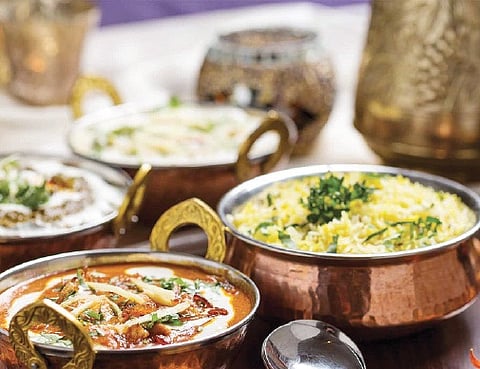

Researchers at the Indian Institute for Technology in Jodhpur have cracked the mystery behind Indian food that has made the cuisine a world favourite. After analysing more than 2,000 popular recipes, scientists have found that the ingredients in the Indian dishes didn’t share flavour compounds that often—which lends to its unique flavours. This is unlike many Western cuisines, where ingredients with similar flavours are paired together.
The researchers have found that the taste of Indian food depends on a clever permutation and combination of flavours at a molecular level. Indian dishes however contain, on average, at least seven different ingredients, none of which share any similar qualities. This means each ingredient brings its own unique flavour when incorporated into the final dish. The researchers concluded that Indian cuisine is characterised by strong negative food pairing; the more the extent of flavour-sharing between any two ingredients, the lesser their co-occurrence. “Each of the spices is uniquely placed in its recipe to shape the flavour-sharing pattern with the rest of the ingredients, and is sensitive to replacement even with other spices,” said a researcher to an international daily.