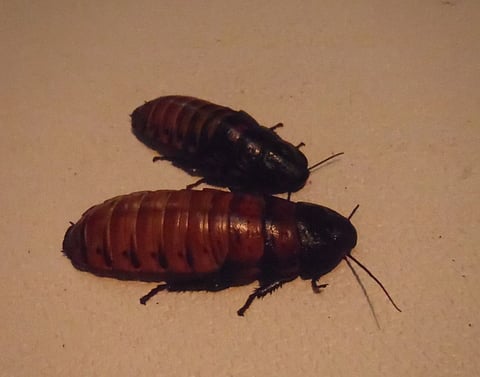

BENGALURU: Buffalo milk, a staple of humans, has long been thought of as being the most nutritious food in the world. Till researchers found ‘cockroach milk’!
Before you get grossed out, ‘cockroach milk’ is not yet an edible substance, but if researchers manage to convert into a yeast, it could become a popular diet supplement for sportsmen and body builders — much like a protein drink, because it has three times the calorific value of buffalo milk.
Researchers at the Institute for Stem Cell Biology and Regenerative Medicine, Bengaluru, who accidentally discovered ‘cockroach milk’ call it a ‘complete’ food, as it is packed with every major nutritional component one would require—fat, sugar and protein. And what’s surprising is that this ‘superfood’, though a substance found in the gut of roach embryos, does not, under the microscope, seem like the nausea-inducing image in one’s head when introduced to the word ‘cockroach milk’ — it is, in fact, quite beautiful in its shiny, crystalline form.
These milk crystals are produced only by the Pacific Beetle cockroach, commonly found in Hawaii, and not your average kitchen pest. It is the only breed of the roach that gives birth to live young ones like mammals, instead of laying eggs.
Prof Ramaswamy Subramanian, who heads the research team at of the Institute for Stem Cell Biology and Regenerative Medicine that made the baffling but fascinating discovery, says they did not start with an idea of finding an alternative for the world’s dairy needs. What started as one of his student’s curiosity was translated into an interesting finding after 10 years of scientific effort. Now Prof Subramanian’s team is working on reproducing this en masse in yeast form.
Reasoning that the research is well worth the time spent on it, the professor says, “We think of buffaloes as very evolved but here there’s the cockroach which has survived the ice age and can make milk of much more calorific value. It is complete in a simple crystalline fashion. If it weren’t for the calorific value, I wouldn’t spend my time making this in yeast. It has protein, fat and sugar, three different properties that make it interesting.”
Armed with the support of research institutes in US, Japan, Canada and France, he contends these milk crystals can be great protein supplements and also be used to design nanoparticles for drug delivery owing to its perfect crystalline form. He believes he can mass-produce this milk through a synthetic technique that converts it to yeast, and that this would make it as far removed as possible from its origins, the cockroach, which most people (except some world cultures that consume the insect as food) find disgusting.
Prof Subramanian does concede that his research lab does not have the wherewithal or the chemical engineering required to scale it up. “It started purely as scientific curiosity. The fact that it turned out to be food of high calorific value are all accidents. This is how you make discoveries that are disruptive and not incremental,” he said.
While one of his co-researchers has been brave enough to taste the milk, he hasn’t mustered the courage to sample it himself. “As soon as we make it in yeast form, I’ll be one of the first to taste it,” he quipped.