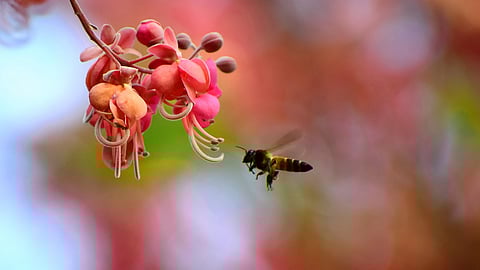

A bee lands on a flower, its tiny body dusted with pollen. Moments later, it lifts into the air and settles on another blossom, leaving behind the beginning of a seed. Repeat that exchange millions of times across farms, and entire harvests quietly come to life.
But the world’s smallest agricultural workers are vanishing and technology is beginning to answer the crisis.
Artificial intelligence, computer vision and remote sensing are beginning to watch the lives of bees with an attention that once belonged only to beekeepers. Sensors can track how bees move through landscapes, algorithms can map flowers across fields, and data can reveal the invisible highways that pollinators follow between crops. What was once guesswork is slowly becoming science.
In Vadodara, beekeeper and innovator Dipen Patel is experimenting with a quieter kind of hive. Patel, President of the Gujarat Beekeeper Development and Honey Producers Co-operative Society, has developed an automatic beehive inspired by “Flow Hive” technology.
For centuries, harvesting honey has meant opening a hive, lifting frames heavy with wax, and spinning them in extractors. It is a noisy, disruptive ritual that unsettles the colony. Patel’s design changes that rhythm. With a simple turn of a key, honey can flow directly from the hive without opening it at all. The bees remain undisturbed, the colony remains calm, and the work continues.
Such small shifts matter more than they once did.
Because every morning, when a bee leaves its hive and disappears into the air, it carries with it a responsibility far greater than its size. Pollination — the quiet transfer of pollen from flower to flower — underpins nearly 70–80% of the crops that feed the world. Sunflower fields, mustard blossoms, cucurbit vines, fruit orchards and vegetable farms all depend on this invisible labour.
Yet these silent contributors are disappearing.
Across India, scientists are beginning to see the numbers fall. Research by institutions including the Indian Agricultural Research Institute shows that the country’s bee colonies have declined from around 1.5 million in 2010 to roughly 0.92 million in 2023 — a loss of nearly 40%. Native species such as Apis cerana and Apis florea have suffered some of the sharpest declines.
“Protecting pollinators is no longer only an environmental concern—it is an agricultural necessity,” said Dr Vanam Sunitha, Professor of Entomology at Professor Jayashankar Telangana State Agricultural University.
One of the most dangerous threats, she explains, lies in the chemicals meant to protect crops themselves. Pesticides such as imidacloprid, thiamethoxam, clothianidin, chlorpyrifos and fipronil can disrupt a bee’s navigation and survival. A bee that cannot find its way home is a worker lost forever. Researchers are encouraging farmers to shift toward safer alternatives such as neem-based azadirachtin, Bacillus thuringiensis and spinosad, and to spray fields in the evening when bees are less active.
But the pressures do not stop there.
Climate change is beginning to shift pollination patterns. Conservation ecologist Rajashekar Tummala says the survival of bees depends not only on chemicals but also on landscapes.
“Trees such as neem, Persian lilac and Alstonia, along with flowering plants like tulasi and lavender, provide year-round forage for bees,” he said.
Yet climate change is quietly rearranging nature’s calendar. Flowers bloom earlier. Pollinators emerge later. When these timelines fall out of sync, pollination falters. In semi-arid regions like Telangana, rising heat shortens the hours bees can forage, while erratic rainfall disturbs flowering cycles in crops such as pigeonpea and sunflower. To understand these shifts, scientists are turning to predictive ecological tools — models such as MaxEnt, Random Forest algorithms and phenological systems like ILCYM that can forecast pollinator behaviour under future climate conditions.
While researchers study the science, others are working directly with the insects themselves. In Pune, bee conservationist Amit Godse has spent years rescuing colonies that would otherwise be destroyed. As founder of Bee Basket, he and his team carefully relocate hives from buildings and neighbourhoods into safer habitats.
“Bee populations can be increased through rapid multiplication of colonies and by reducing harmful pest control practices,” Godse said. Since 2016, his team has rescued more than 19,000 hives — thousands of small colonies returned to landscapes where they can continue their quiet work.
For now, their survival will depend on farmers who change their practices, scientists who rethink agriculture, and communities willing to protect the landscapes bees call home.
Because saving the bee is not simply about preserving an insect. It is about protecting the fragile, humming engine that keeps the world’s food growing.
