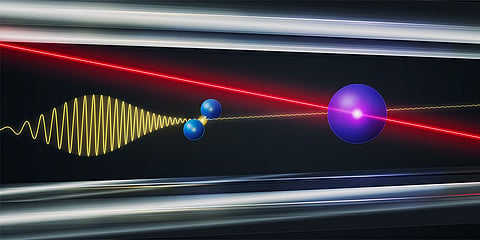

Researchers at the University of Basel have successfully identified and controlled extremely weak, so-called ‘forbidden’ vibrational transitions in individual nitrogen molecules without destroying them, marking an important step towards developing highly precise molecular clocks and quantum bits.
The findings, published in Nature Communications, were reported by a team led by Professor Stefan Willitsch from the University of Basel’s Department of Chemistry. Forbidden transitions between energy levels are not impossible but extremely unlikely, making them more than a billion times weaker than ordinary transitions. Their sharply defined frequencies, however, make them valuable for precision measurements.
The researchers studied positively charged nitrogen molecules, known as molecular ions. Willitsch’s group had first observed forbidden molecular vibrations in 2014, but the chemical detection technique used then destroyed the molecules during every measurement cycle. “To achieve the highest precision, it is much better to perform experiments on single molecules, and not lose them in the process,” Willitsch said.
To overcome this limitation, the team employed quantum-logic spectroscopy, using a calcium ion as a messenger. A nitrogen molecular ion and a calcium ion were trapped together. While the nitrogen molecule could not be readily detected through light, the calcium ion was made to glow using lasers, allowing researchers to determine the molecule’s energy state indirectly.
The team varied laser frequencies to excite the forbidden vibrations and used a second pulse to return the molecule to its initial state. This reversible process allowed repeated measurements on the same molecule. “Using the same molecule again and again was crucial. It made the search for such faint lines feasible,” said first author Dr Aleksandr Shlykov.
Measurements involving several hundred individually prepared molecules helped determine the fundamental vibrational frequency ten times more precisely than previous measurements. The transitions could also support molecular clocks, quantum bits and investigations into whether proton and electron masses remain constant over time.
