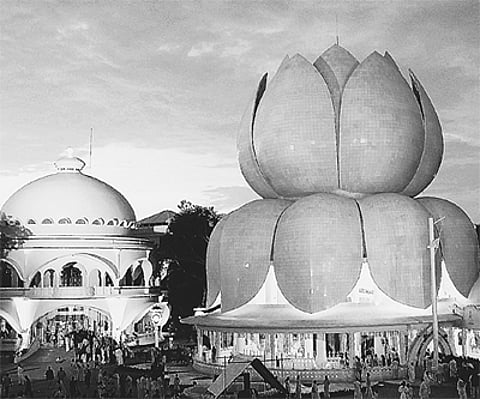

The lotus in white marble is visible from afar, illuminated by the evening light.
A winding driveway takes us past the cavernous pool—the remnant of a granite quarry—and quaint shops, to the Santhigiri ashram on the hills of Pothencode, near Thiruvananthapuram, where Sri Karunakara Guru lived and spread his message until 12 years ago.
On the white, sandy expanse before the ‘Parnasala’ is a monument in the shape of a lotus in full bloom, built on the site where the guru was laid to rest in 1999.
A festive mood marked the tranquil surroundings, for the ashram was inaugurating a month-long celebration to mark the 85th birthday of the guru, on September 2.
Stories abound about the guru’s miracles. Years ago, when he and his followers reached the place that was eventually to become the ashram, the whole area was a dense forest. Digging for water did not yield results: the guru sighed in despair and the well filled up with water, the dry leaves swirling up as the water rose. The Universe had heard his despair and had responded.
Karunakara Guru wasn’t formally educated: he addressed the ontological and the mundane in a simple but intimate style. His message was simple and ancient: follow a guru, for that path is the most blessed one to salvation. ‘Om Sree Karunakaraguru parabhramane namah, Om Sree Karunakaraguru Satyapradaya namah’ goes the prayer.
The guru is the embodiment of the Supreme Truth; he bears the sins of the follower. At Santhigiri, a unique tradition prevails: of the jananins— sybils who communicate to the seeker the path he should follow. Today, Santhigiri does not even vaguely resemble the thatched hut, amidst the woods, 15 years ago.
The guru’s abode stands on its original site. The guru had prophesied the transformation of the ashram, and the coming up of the Parnasala, which he had said, would become the eternal symbol of Santhigiri. The prophecy has blissfully turned into reality, with thousands of devotees thronging to experience the harmony of architectural beauty, along with the healing powers of nature and the omnipresent blessings of the guru.
Long after the guru passed away, the ashram blossomed into this grand lotus that enfolds two schools of healing; Siddha and Ayurveda medical colleges, two huge drinking water projects supplemented by rain-water harvesting and cottage industries spread over centres functioning across the length and breadth of Kerala.
At the prayer hall, Stephan smiles, as he hands out ‘theertha’ and ‘vibhoothi’ to devotees. “Accept these with all your heart and sincere reverence and your soul will be cured,” says the German sanyasi, who has been living in Santhigiri for 10 years now. Each time he opens the platter containing the ‘vibhoothi’, Stephan assumes a prayerful expression, as if the deed of touching the sacred ash is in itself a form of submission.
The prayer hall is the only place in the complex where a picture of the guru is visible. Archana, another devotee, says the norms followed here are directions revealed to the ashram’s parampara, nurtured by gurus with visionary powers.
The structure of the Parnasala was thus revealed in a divine visitation to Sishyapoojitha, the first revered among Sri Karunakara Guru’s disciples, while he was alive. Asking his dear disciple not to fret over the recurring dream, he had told her that a time would come when the structure would rise on these hills.
He had stopped short of revealing the context of his departure to merge with the ‘Adi sabkalapa’, which would occasion the birth of the white lotus.
The sheer power of the guru’s will now presides over the ashram, lending it the energy and rhythm to create the symphony of human brotherhood.
Many, like Stephan and Archana, have not seen the guru in his physical form.
Yet, they submit to the force that soothes their souls and bonds their lives to the ashram.
Sree Karunakara Guru’s grace remains an evanescent presence in Santhigiri.
