
Why should I see reality as it is? What is wrong if I do not have a clear understanding about life? Swami Tejomayananda, the head of the Chinmaya Mission worldwide, raised these questions at the inauguration of a week-long camp with over 280 participants from around the world at the Chinmaya International Foundation in Kerala’s Vellianad, near Ernakulam. The question, he said, is similar to a person with an eye defect asking, “Why should I correct my eye defect?”
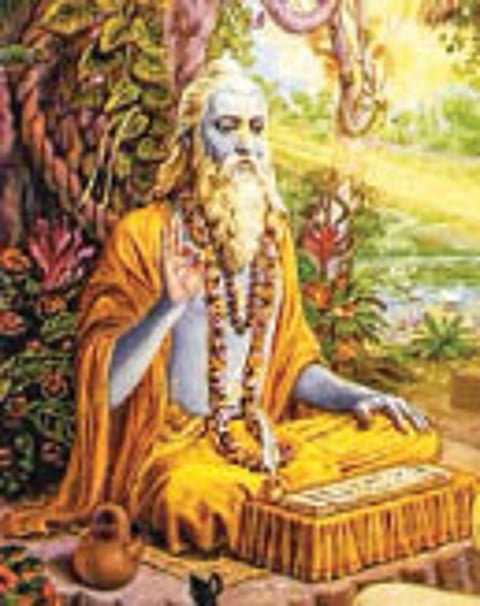
Brahma Sutras is authored by Shri Veda Vyasa, the first editor of the Vedas. There are 555 pithy aphorisms on the Brahman. The greatness of the event happening at the spiritually vibrant Adi Sankara Nilayam, the place where Adi Sankara, the greatest proponent of Advaita Vedanta was born is of great significance because it was Sankara who wrote the Bhashya or commentary to explain the Brahma Sutras. Terse and in a very difficult to understand style, the Brahma Sutras would be far out of reach for the common intellect without this commentary by Adi Sankara.
Swami Tejomayananda gave a very new dimension to the importance of understanding the three main books for studying the Indian way of thought called the Prasthana Thraya—the Upanishads, the Brahma Sutras and the Bhagavad Gita.
The Upanishads are a means of knowledge to know one’s own self. It is like a mirror. To ask, “How many Upanishads do I need to study to know the truth?” is like asking how many mirrors I need to see my face? It is very important to understand the Upanishads properly—the right understanding liberates and the wrong understanding creates more bondage. This is the reason why the Guru is most essential in our path to find the truth. Prasthana means departure and these three texts show the way for people to depart from ignorance to reality!
The Brahma Sutras are analyses based on the essential thoughts of the Upanishads—reconciling the contradictions and explaining how the subject should be understood. While the Upanishads tells us who we really are, the Brahma Sutra analyses and clarifies and the Bhagavad Gita is a text that shows us the path to live life in tune with this knowledge.
Brahma Sutra is a text that talks relentlessly only about the highest truth and it is so very easy to doze off while listening to it. However the speaker never let that happen with his most brilliant jokes and anecdotes that were both witty and enlightening. Our errors of perception can be really costly, he says quoting an example. A fielder in cricket has an eye problem. He sees two balls instead of one. When the ball is coming close to him, he gets ready, but when it is time he catches the unreal ball and the real one makes a third ball in his head!
(www.swahilya.blogspot.com)