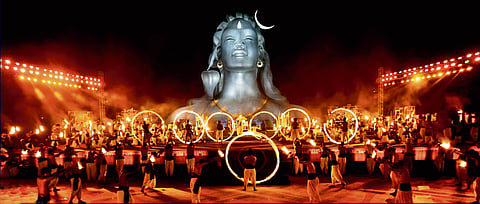

Every year, as Mahashivaratri approaches, an ancient rhythm returns across India. Temples remain open throughout the day, bells ring past midnight, devotees fast, chant and meditate, and millions keep vigil until dawn. From the Himalayan shrines of Kedarnath to the temple towns of Tamil Nadu, the night of Shiva has long been marked by wakefulness, prayer and celebration.
Yet, in recent years, the most widely discussed Mahashivaratri celebration has not been in a temple town but at the Isha Yoga Centre near Coimbatore, Tamil Nadu. Its scale, performances and global livestreams have drawn enormous audiences.
At the same time, they have also drawn a familiar wave of scepticism—a lot of it, motivated or uninformed. Critics dismiss the event as spectacle masquerading as spirituality, suggesting that lighting, music and celebrity appearances somehow dilute religious authenticity. The charge rests on an unspoken assumption: that genuine spirituality must be austere, visually restrained and silent. Collective celebration, technological amplification or visible enthusiasm appear, in this view, to compromise the sacred.
But Indian religious history suggests precisely the opposite. I say this not as a historian but also a recent observer. I attended this year’s Mahashivaratri celebrations at Isha and arrived with the professional scepticism that years of archival research tend to instil in one, making them a misanthrope. Historians are trained to distrust spectacle. Yet, what unfolded through the night was difficult to dismiss so simplistically.
Before us stretched a vast gathering—lakhs seated under the star-lit sky, waiting for the vigil that would carry them until dawn. Music moved across traditions: Carnatic compositions, folk melodies from Rajasthan, Maharashtra, Tamil Nadu and Gujarat, and rhythmic chants of Sadhguru Jaggi Vasudev rising and falling across the crowd. At moments, the gathering erupted in a dance aided by those lilting Indian folk tunes, at others, it settled into stillness during guided meditations. What lingered most strongly were those intervals of silence when thousands seemed to sit in collective stillness. I had planned to leave after an hour or two but stayed almost until five in the morning.
The following day, headlines focused on the numbers: millions watching through livestreams, broadcasts in multiple languages, and digital engagement reaching audiences in more than a hundred countries. To critics, these statistics confirmed their suspicions that Mahashivaratri at Isha had become a spectacle rather than a spiritual observance.
But the history of Indian religiosity makes such a conclusion difficult to sustain. For centuries, the sacred in India has rarely confined itself to quiet contemplation alone. The Kumbh Mela—perhaps the largest periodic human gathering on earth—is itself a vast public spectacle of faith. The Jagannath Rath Yatra transforms entire cities into sacred processions. Temple festivals across South India unfold through elaborate chariots, percussion ensembles and night-long participation by entire communities.
Even the Bhakti movements that transformed Indian religious life between the twelfth and eighteenth centuries spread not through silent meditation but through song, poetry and collective devotion. Chaitanya Mahaprabhu’s sankirtans in Bengal, the abhangs of the Varkari saints in Maharashtra and the compositions of the Haridasas in Karnataka carried philosophical ideas into the public sphere through rhythm and emotional intensity.
Why, then, should Mahashivaratri alone be expected to conform to monastic quietude, especially when several traditions believe that the night celebrates the marriage of Shiva and Parvati?
The imagery of Shiv Ki Baraat—Shiva's wedding procession accompanied by his eccentric retinue and ribaldry of ascetics and ganas—has long been depicted with music, dance and ecstatic celebration. To privilege one dimension and denounce the other as inauthentic is to flatten a vast theological tradition.
Seen through that civilisational lens, the Mahashivaratri celebration at Isha is part of a broader pattern in which young Indians engage their civilisational inheritance in technologically mediated ways. For a globalised generation, such events are also an introduction to Indian spiritual traditions, albeit through digital platforms and modern mediums.
But there is a deep, underlying sociological phenomenon. India today has over 800 million internet users, and spiritual or devotional content ranks among the most widely consumed categories online.
The digital reach through YouTube subscriptions of contemporary spiritual teachers reflects this appetite: Sadhguru (12.7 mn), Swami Ramdev (11.6 mn), Bageshwar Dham (11.1 mn), Sri Sri Ravi Shankar (9.47 mn), Brahmakumari Sister BK Shivani (6.37 mn), Gaur Gopal Das (5.17 mn), Jaya Kishori (3.82 mn), Daaji Heartfulness (3.16 mn), Sakshi Shree (1.39 mn), Morari Bapu (959k), Jagadguru Kripalu Ji (802k) and Sringeri Sharada Peetham (264k) to name a few. The T-Series Bhakti Sagar has a staggering 81.5 mn subscribers—numbers that would be the envy of any film star or politician.
In this context, the spectacular Mahashivaratri at Isha is not an aberration. These numbers may not settle theological debates. But they illuminate a social reality.
The Pew Research Centre’s 2021 survey Religion in India: Tolerance and Segregation found that 84 per cent of Indians consider religion very important in their lives. Across India today, numerous centres have sprung up that satisfy the spiritual curiosity of people, especially the youth.
The Art of Living operates in over 150 countries and reports extensive youth leadership programmes. ISKCON maintains vibrant campus networks in major universities worldwide. Mata Amritanandamayi’s institutions combine devotional practice with large-scale humanitarian initiatives. Bageshwar Dham attracts large gatherings across north India. Sadguru Madhusudan Sai’s institutions operate educational and healthcare initiatives across states as does Sakshi Shree of the Siddha Sudarshan Sakshi Dham.
Numerous yoga and meditation movements cultivate global followings. The sociological pattern is unmistakable: young Indians are not rejecting indigenous spiritual frameworks. They are just engaging in them in newer idioms. To dismiss this is to misread the moment.
The students, entrepreneurs and professionals who gather at places such as Isha inhabit a world defined by relentless competition, digital overload and the psychological strains of urban life. In such circumstances, the search for meaning or balance is hardly surprising.
Platforms that combine yoga, meditation, philosophy and cultural expression offer one avenue through which many rediscover elements of India’s civilisational inheritance.
One may debate the ideas of particular teachers or the ethics of their organisations, which is legitimate as well. To dismiss the millions who participate in such movements as gullible followers of cults is, in fact, intellectually lazy.
Civilisations endure not by freezing their traditions in static forms but by reinterpreting them across generations. India’s spiritual landscape has always accommodated many paths—ascetic meditation, temple ritual, philosophical debate, devotional singing and public festivals. The Mahashivaratri vigil at Isha is one contemporary expression within that wide continuum.
As someone who studies India’s intellectual history, I am conscious that proximity can invite suspicion. The defence offered here is therefore not of any individual’s infallibility but of a broader civilisational pattern. For Indian civilisation has never been embarrassed by devotion. It has long been known that the sacred may reveal itself in many ways—in the stillness of meditation, in the cadence of sacred song, or in thousands keeping ecstatic vigil through the night.
Perhaps the real question is not why such gatherings draw millions. The real question is why that fact unsettles some observers. If gatherings such as the Mahashivaratri vigil at Isha provoke discomfort, the reason may lie not in the spectacle but in what it signifies: that India’s civilisational memory is neither fading nor embarrassed. It is being rediscovered by a generation that refuses to inherit it apologetically.
