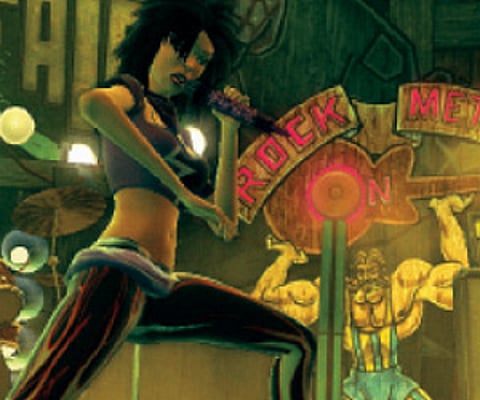

Forget the songs and the standard note chart gameplay for a second. If footage of Rock Band Unplugged is to be believed, it is one of the strangest, and most intriguing fantasy worlds ever created.
You play the role of an omniscient puppetmaster, in charge of four androids pretending to be rock-stars, who need to be wound up like mechanical toys every 20 seconds for them to play their instruments. Sounds hard to believe? Watch your so-called ‘band members’ flail about in a single repeated (embarrassing) animation after you successfully finish a song. Virtual rockstars, my foot. These are androids, my friend. Androids.
That’s not to say that Rock Band Unplugged is in any way flawed. (We’ll have to play it when it comes out later this month to find out) Or less ‘realistic’ than its big console counterparts. Guitar Hero and Rock Band have always been glossy, over-simplified simulations: they depict playing in a rock band about as much as Roadrash depicts being in a motorcyle gang. They distill gameplay elements from the best parts of the real thing, i.e that singular moment of aural unity when the band is in groove, and you’re somehow mysteriously aware of every note being played. Of course, that depends largely on the person behind the sound mixer: who invariably knocks the vocals up to volume 11 while the rest of the band fades into subsonic obscurity.
Anyways, Rock Band. The most important concern with Rock Band (and it’s an excellent title, let it be clarified) is that it’s totalitarian with respect to what you can play. There’s a draconian note chart that must be followed to the letter, and any variation, addition, or improvisation is punished ruthlessly. Unplugged demonstrates this the best, since its gameplay centres around ‘phrases’ that must be played in succession, hitting even a single wrong note could send your band’s performance spiralling down to failure land.
Music has never been about creating carbon-copies of existing songs (unless you’re a tribute band), and while there have been attempts to introduce more improvisation and creativity into these titles, they are mostly piecemeal and...hesitant. Guitar hero: World Tour has drum solo sections where you can hit the pads with gleeful abandon, and Rock Band has ‘big finishes’ that unleash your hidden button masher for a few seconds.
But these have little rhyme or reason, and serve as little more than excuses to temporarily alleviate the tyranny of the note chart. Guitar Hero IV even dabbled with a music creation tool, but it seems to be little more than a feature checklist that is at the back of the box.
The problem is that these two titles have becomes staples of the so-called ‘rhythm game’ genre, so much so that alternative viewpoints, like Nintendo’s much maligned Wii Music are steamrolled by the Guitar Hero/Rock Band juggernaut. Wii Music was a title that rewarded, rather than punished, improvisation: offering clever, understand audio cues to encourage the player when they were getting into the spirit of the song. It had its problems, yes. It was far too simplistic, and its nursery rhyme setlist no match for the big-label flaunting Guitar Hero, but as a gameplay alternative to what is now seen as the be all and end all of the music game, it was very important.
Meanwhile, the parade rolls on. Guitar Hero V is due later this year, as is The Beatles: Rock Band (rumoured to support multiple mics for vocal harmonies). Rock Band creators Harmonix have often stated that they were set up on the premise that learning music could be more accessible, and less scary. While they’ve definitely taken the first step towards that goal, we’d like to see the next leap forward now. More fun, more creativity, less rote gameplay, yeah?
—krish.raghav@gmaii.com