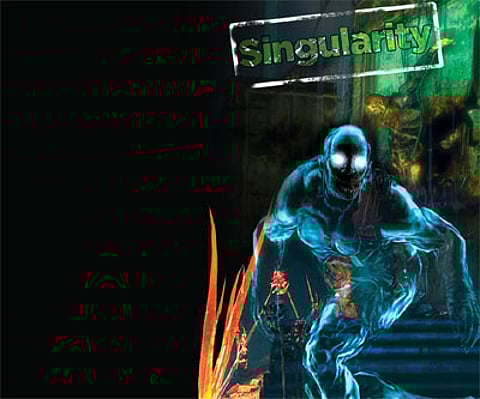

Developers Raven Software have made some world-class FPS titles in the past, including Heretic, Hexen and their sequels, the first two Solider of Fortune games, Star Trek Elite Force I & II, and in my opinion, the best single-player Quake game, Quake 4. While their games didn’t necessarily sport great multiplayer, I do remember having an obscene amount of fun with Star Wars Jedi Knight: Jedi Academy. Their latest effort, Singularity, follows tradition, and is one of those games that ambushes you, literally from nowhere, delivering one of the most atmospheric and solid FPS experiences this year.
Games like Singularity simply don’t get made anymore. The shooter genre is dominated by big franchises backed by marketing muscle — I’m talking about games like Call of Duty, Half-Life, Halo and third-person shooters like Gears of War. Even Bioshock, for that matter, was loosely based on the mechanics of the truly brilliant System Shock 2, with 2K Games effectively leveraging the success of that game. It is arguable that these games would fall under this ‘category’ I have conveniently placed Singularity in when their respective first versions were released, with the decision to develop sequels being based on the success or failure of those games. But then again, the market at that point wasn’t littered with hugely successful FPS franchises which sold over five million copies within the first couple of weeks of release. However, like Escape From Butcher Bay and FEAR before it, Singularity will quite possibly eclipse its competition this year.
It is difficult to attach a specific time-period to the setting of Singularity. I mean, I’m sure it’s possible, just not without an extremely long quantum physics formula. Set on an Island-research base called Katorga-12 in modern-day Russia, it follows a US Special Forces team that is despatched to the region to investigate an electromagnetic surge that knocks an American satellite out of orbit. You play as Captain Nathaniel Renko, a member of the team sent to investigate the mysterious interference. As the chopper approaches the island it is unsurprisingly destroyed, leaving only a couple of survivors. Going back in time, we learn from a video that the Soviets discovered an isotope called E99, and under Stalin’s orders, began conducting experiments on the mysterious island. An accident during this research resulted in the supposed deaths of everyone working on the project and a subsequent cover-up of the same
ensued. Playing as Renko, your orders are to get to the bottom of this mystery and get out of there in one piece.
The game, as the title suggests, has a lot of science-related things in it — like science-bombs, science-guns and science-WMDs. There’s also a lot of time-manipulation, time-travelling and ‘ageing’ — as in, not you getting older or younger, but the ageing of objects and enemies (‘ageing’ enemies kills them
instantly). All of this is made possible by the game’s TMD or Time-Manipulation Device which you get hold of an hour-or-so into the game. The TMD is similar to Half-Life 2’s gravity gun, but has the added function of being able to obliterate enemies by ‘ageing’, slow or knock them down with the ‘impulse’ ability. While the TMD plays a crucial role in several environmental and physics-based puzzles, it’s pretty handy in a fight too. Combining its use with firearms almost always yield good results. In fact, some of the enemies are very difficult to beat without the TMD and while you can fight your way through most of the game’s enemies without it, it is indispensable at times. The best part about the TMD is that it doesn’t just sound great in theory, and like the extremely competent shooting mechanics, the TMD works great in practice too. Singularity’s weapons while pretty generic, can be upgraded to cause more damage, accommodate larger clips or slow reload time. No weapon particularly stands out — not even the ‘seeker’, which fires a controllable projectile or the Wolfenstein-like Mini-gun, but the game’s solid FPS mechanics make garden-variety weapons such as the Valkyrie assault rifle and Volks shotgun a dream to shoot. Med packs can be carried, are abundant and essential (since the game doesn’t feature a regenerating health system), while other ‘loot’ includes E99 parts (which are needed to perform upgrades), stim packs and Call Of Duty-style ‘perks’ which offer bonuses such as health boosts, better accuracy and more. It’s an awful lot to manage, to be honest, but very well thought out, adding a lot more depth to the already engaging single-player campaign.
To sum it up, Singularity feels like a Bioshock/Half-Life/Call of Duty hybrid, drawing inspiration from all those games and adding more than just toppings to the mix. The Katorga 12 facility just screams ‘Cold War Soviet Union’, with authentic-looking structures, machinery and propaganda material littered about. Scattered tape-recorders and notes tell the story of various people who were at the facility when things went wrong, while deserted houses, offices and research labs tell you more with their eerie silence. It’s not just the silent, exploratory sections of the game that ooze atmosphere — the frantic chases, set-pieces and phasing in and out of time periods that often make you forget you’re playing a poorly marketed shooter from the developer that gave us the incredibly-average ‘Wolfenstein’ last year. Strangely, Singularity develops on some fundamental time-warping concepts that formed the basis of Wolfenstein’s gameplay. Who knew it would evolve into something brilliant?
Verdict
Despite its dated graphics engine, Singularity is a stand-out title with solid FPS mechanics, atmospheric setting and great story.
— videep@gmail.com