
Using Flagstaff as our jumping-off point, we decided to meander north on US Highway 89. Sunset Crater Volcano National Monument wasn’t part of the plan, but a roadside sign announcing it caught our attention. Its name intrigued me, and I thought this could be one of our hidden gems.
The colourful 3,040-acre park is easily
enjoyed in relative solitude. Black rock with touches of green and yellow lichen covers most of the Bonito Lava Flow, near the park entrance. Red and orange glaze the top of Sunset Crater Volcano, the park’s namesake.
Legend has it that 19th-century explorer John Wesley Powell gave the crater its name because he thought its rim resembled a sunset. Just up the road from Sunset Crater is Wupatki National Monument, with picturesque scenery and pueblo ruins.
The largest of these is the Wupatki Pueblo which, in the 12th century, had 100 rooms holding as many residents. You can tour the pueblo grounds, including the ball court and community room.
Wupatki and Sunset Crater Volcano
national monuments charm but didn’t
enchant me. I wouldn’t plan a trip just to see them, but they’re great stops on the way to the Grand Canyon or southern Utah. Together, they offer two distinct experiences for the price of one detour.
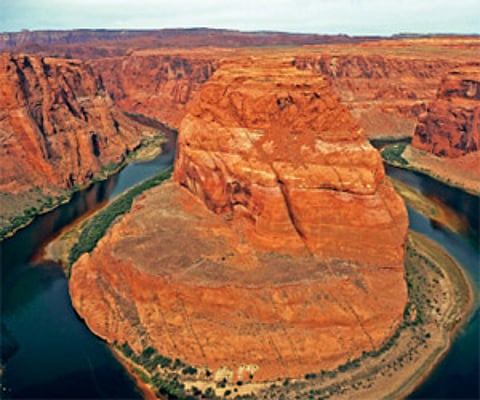
From Sunset Crater and Wupatki, we drove two hours north on US 89, heading for Horseshoe Bend. Although it’s part of the Glen Canyon National Recreation Area, nothing about it initially seems remarkable. You can barely find it from the highway. The parking lot is small and dusty. Furry caterpillars
meander across the 3/4-mile trail. But if you trudge on, what you encounter is nothing short of amazing.
Vistas from the cliff’s edge offer crisp views of the Colorado River 1,000 feet below as it cuts a horseshoe into the land. Seeing Horseshoe Bend recalled the wonder I felt gazing at the Grand Canyon for the first time. Although the latter’s magnitude makes comparison absurd, I appreciated that I could take in Horseshoe Bend in one gulp.
Worth a visit? Yes, definitely. But again, make it a stop on a larger trip. You would be hard-pressed to spend more than an hour or two at Horseshoe Bend. The view is stunning, but aside from the trail to the edge of the cliff, the area doesn’t lend itself to hiking. For a complete experience, pair Horseshoe Bend with nearby Antelope Canyon.
“Where is it?” I asked myself, waiting
for our guide to lead us into Lower Antelope Canyon. Off state Highway 98 on Navajo
land about 11 miles east of Horseshoe Bend, it looks like any other stretch of desert.
But descending into this canyon, you feel
as if you’ve stepped into an elaborate art
installation. The slot canyon’s walls, formed from sandstone, convulse into elaborate
abstract shapes.
Light shines unevenly inside, casting bright patches in some places and shadows in others. Every turn you take yields a new sight. Not for the passive walker, Lower Antelope Canyon is an interactive experience. You climb and squeeze your way through. Some sections are so narrow that only one person at a time can pass. At the steepest points, visitors can continue only with the aid of metal stairs.
I dare say I enjoyed Lower Antelope Canyon more than the Grand Canyon. You can hike here. The photographic opportunities are terrific. Access to the canyons, which make up the Antelope Canyon Navajo Tribal Park, is by guided tours only, which start at $20, not including the $6 admission. We jumped back on 98, heading east for about three hours to US Highway 163, where we saw enormous rock formations rise as we neared the Arizona-Utah border. The towering presence of Monument Valley amid the flat landscape made me feel as though I had stumbled on the land of giants.
Monument Valley, the backdrop for numerous Hollywood westerns, is a concentration of towering sandstone rock formations, some more than 1,000 feet high. A 17-mile drive winds past the valley’s formations, including the Mittens, Grey Whiskers, King on His Throne and the Three Sisters. For the most part, the monuments resemble their names.
Monument Valley left me only mildly
impressed. During the 17-mile drive, I felt as though I was seeing the same monuments, as grand as they were, over and over again from different angles. For me, visiting the valley was a passive experience. We drove, got out at scenic vistas and snapped a few photos. Because Monument Valley is a Navajo tribal park, climbing is not permitted.
My friend had a different opinion and
was entranced by the valley’s grandeur. Maybe I didn’t get the full experience, because
the $5 admission gives you access to just one-third of the park.
I skipped the guided tours, which start at about $50 and can cost more than $100. Some parts of the valley, including the Anasazi ruins of Mystery Valley, are accessible only by tours that use routes not open to the public. If you’re interested, you can sign up at the park
entrance or book ahead. If you go, take your time and don’t be stingy.
For the last leg of our road trip, we decided to check out Petrified Forest National Park, about a four-hour drive south of Monument Valley. For the longest time, I had imagined that the Petrified Forest was a prehistoric jungle frozen in time. The reality, while still impressive, is less fairy tale-like. The trees were formed more than 200 million years ago when they were washed into streams and buried under sediment, so none stands
upright. The trees, however, wear an impressive palette of colours from minerals — mostly quartz — that formed in lieu of organic matter. The Petrified Forest doesn’t lend itself to a quick stop. Driving the 28-mile road that leads past most of the park’s sights takes at least an hour, not taking into account stops. Photographic opportunities abound at the Painted Desert, a colourful collection of hills, buttes and mesas carved by millions of years of erosion. The Blue Mesa Trail carries you into the bowels of the Painted Desert’s badlands, an alien-like landscape strewn with kaleidoscopic petrified wood.
Along with the Lower Antelope Canyon, the Petrified Forest was a highlight of my road trip. From there, we raced 90 miles west on I-40, intent on reaching Meteor Crater. The 50,000-year-old chasm, gaping like a wound that never quite healed, sits on private land owned by the Barringer family.
Viewing the immense crater — it measures 4,000 feet across and 550 feet deep — elicited thoughts of the impact. Seeing the shape of the crater from its rim, you can guess the meteor’s trajectory as it struck the Earth. I had seen only aerial photos of Meteor Crater before visiting. A closer look left me less
impressed. From its rim, the crater looks more like a valley, the violence of the prehistoric impact worn away by time. But maybe my wonder was mitigated by the 1,100 miles we had driven or the 400-mile drive home we had ahead of us. Or maybe it was the $15
admission, which came to about a buck for each minute I spent at Meteor Crater.
In just three days, I had seen a lifetime’s worth of canyons, badlands, craters, mesas and buttes. But, for me, Lower Antelope
Canyon and the Petrified Forest were the true hidden gems.
— LAT-WP
factfile
Arizona is located in the southwestern region of the United States. Phoenix is the capital and also the largest city. The second largest city is Tucson. Arizona is noted for its desert climate, exceptionally hot summers and mild winters.
In addition to the Grand Canyon, many other
national forests, parks, monuments, and
Indian reservations are located in the state.
