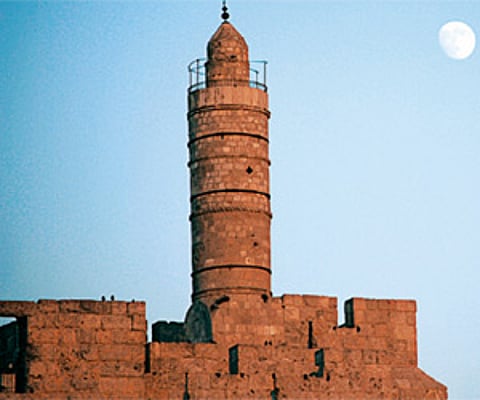

W ith most of its buildings looking old and shabby, Jerusalem may not have a photogenic face, but the moment you reach the place you feel a sense of holiness around you. Sacred to billions of Jews, Christians and Muslims the world over, it is the capital of modern Israel and is, in fact, a 3000-year-old metropolis. The sanctity of the land emerges from the traditions and faith of the three monotheist religions — Judaism, Christianity and Islam, all of which originated there from patriarch Abraham.
This religious cliché has, for years, lured secular pilgrims like me to visit Jerusalem for a first-hand experience of their coexistence. And there is no shortage of substantiation, the first that struck me was all signage in three languages, Hebrew, English and Arabic, assuming language bears a link to religion. Jerusalem is a small city, only 48 square miles in size. However, the battle for its soul began three millennia ago. Since then armies of ancient Egypt, Assyria, Babylon, Persia, Greece and Rome marched through this land, fought battles, set seas aflame, and stained almost every stone with blood to claim sovereignty.
Like many, I kept wondering about what did actually lure the mighty empires to fight for this tiny piece of land — was it the geographical location or the religious credence. According to Judith, an ancient history specialist in Jerusalem, both rationale are valid. Unfortunately, the hunger for land still continues, though in the past century, after the formation of Israel in 1948, the feud is now between two groups of people — the Jews and the Arabs, who live together in the city with invisible walls of distrust between them.
The metropolis is broadly divided into two quarters — old and new. The newer part is modern and well groomed, but it’s the old part that draws the visitors with its mystic charm. Dotted with mosques, churches and synagogues, the entire domain is just like a huge pilgrimage centre; it’s the heart of the three faiths where Abraham moved, Jesus prayed and Muhammad ascended.
While the atmosphere is charged with the ringing of church bells, sounds of prayer calls from the mosques or chanting from the Torah, the narrow streets of the old quarter are crammed with a flood of devoted Jews, dressed in long black coats and hats, white bearded Greek Orthodox priests wearing black cassock and Muslim clerics in long robes. Being descendants of Abraham, sons of Ishmael and Isaac, they are brothers, but I noted that there was no exchange of brotherly greetings between them, nor any sign of bitterness in their expressions. Maybe it is the usual way of exhibiting tolerance while men in olive green, standing with their AK47 to keep peace, were in close attendance. The aura that surrounds the place is a function of the strong belief of the devoted that the land is blessed with God’s physical presence.
The Jewish kings, Solomon and Herod, built wondrous temples to house their God on the site where legend says Abraham was about to sacrifice his son Isaac or Ishmael, but unfortunately they were later destroyed by foreign invaders. Nothing remains today of the grand edifice that housed the Ark of the Covenant, a sacred chest holding the tablets inscribed with the Ten Commandments, except part of a retaining wall which is famously known as the Western Wall or the Wailing Wall where Jews congregate and weep for the destruction of their sacred temples.
“A divine presence still remains here for us,” said Ben, my Jewish guide who escorted me around the precinct. So strong is their faith, that as a tradition they write messages on a piece of paper and squeeze them in to the cracks of the wall, and
believe that God will respond to them. And this messaging to God is not for Jews only. Anyone, irrespective of their religion, can do it. The only requirement is that you have to wear a skull cap to touch the wall. Ben told me of a modern innovation to this old tradition — these days one can even fax their message to the Western Wall office and it will be wedged in.
Next to the Western Wall is the Dome of the Rock, the third holiest shrine of the Muslims after Mecca and Medina, as they believe that their prophet Muhammed visited the site in his fabled night journey from Mecca to heaven, as described in the Quran. Devoted pilgrims throng there to soak up the atmosphere. Glittering in the bright sunlight, the dome with golden leaves dominates the city’s skyline and proffers a tempting appeal to go near it and revel in its beauty. Unfortunately, I couldn’t make it as they have very strict visiting rules for non-Muslims.
The labyrinthine old quarter is a maze of narrow and twisted cobble stone alleys, flanked on both sides by houses or shops mostly owned by Arabs, selling everything from fruits, vegetable, spices, sweets, and clothing to Kodak cameras and Duracell batteries. Hunt for souvenirs there, bearing in mind bargaining is a part of the fun. I brought the price of a silk scarf down from 40 to 15 Shekels. The surrounding sights, sounds and smell, made me wonder at times if I was in Israel or any other Arab country, though you will encounter a different scene in the newer parts of Jerusalem.
Via Dolorosa, meaning Way of Sorrow in Latin, is one such narrow alley, that appeared unexceptional at first, but the path is so sacred for the
Christians that it’s packed with pilgrims. It was along this stretch that Jesus made his last fateful walk, carrying the cross from the point of trial to his execution. To walk along this trail is an invigorating experience for any believer, as if you
are sharing the pain and humiliation of a prophet who was born to help humankind. I picked up a handful of dust from the path, thinking maybe one or two from there could have footmarks of the Lord. The journey ends at the Church of Holy Sepulchre which was built in the 4th century at the location where Jesus was crucified, then died, buried and resurrected.
Inside the church, the custody of which is
divided among the several Christian creeds —
Armenians, Greek, Coptic, Roman Catholics, Ethiopians and Syrians, the queue to visit His tomb is always very long, but it is worth the wait. In dimly lit surroundings, standing on Christianity’s most blessed ground sparks a sense of spiritual accomplishment within you.
Ben guided us to the nearby Mount of Olives to present an unbelievable spiritual fact of the city. From the top you get magnificent views of the old city including all of its holy places, but what’s
interesting is that from any panorama or any angle you try to spot a monument from one faith, it will miraculously include one from another. This again signified to me the congruence of faiths, one
inseparable from the other, as they are linked by Abraham and his sons Ishmael and Isaac.
While returning home with unforgettable memories of witnessing intense faith and devotion, I thought that, if part of the vigour behind the
religious cliché could be used by the sensible to establish a culture of peace then perhaps we would be living in a different world today.
—Sandip is Sydney-based travel writer.
sandiphor@hotmail.com
factfile
Getting there: Fly Singapore Airlines
(www.singaporeairways.com) from Chennai or Bangalore to Cairo via
Singapore and take an Air Sinai to Tel Aviv. Accommodation: Stay at the Grand Court Hotel (www.grandcourt.co.il) in Jerusalem. Tour Operator:
Contact Naftali Tours
(www.naftalitours.com) in Israel
for Air Sinai ticket from Cairo
to Tel Aviv as well as for
Jerusalem tours.