
Here in Bangkok, you may spot an elephant or two sharing the road space with fast-moving vehicles and hordes of pedestrians. While the scene is amusing, sad stories hide behind them. Elephants are highly revered not just in the energetic capital city of Thailand, but across the country. They take a high place in Thai monarchy and religion and are almost part of the day-to-day life of the people here. Unfortunately the numbers are dwindling; today there are around 2,000 wild ones and just over 3,000 domesticated, compared to a total of over one lakh a century ago.
Historically the domesticated clan, being the only vehicle capable of penetrating through the thick jungles and climbing steep slopes, were the brawn of the Southeast Asian nation’s rich timber industry. They were trained to pile, push and carry logs by their respective mahouts or masters, virtually poor villagers, with whom they established a lifelong bond since their birth.
However with modernisation, the traditional forms of work for elephants are rapidly fading, especially after the Thai government banned logging. Moreover when mahouts shift from the wilderness to the cities to earn a better living, it badly affects the jumbos as they are not able to get accustomed to the urban settings where green perhaps means the colour of a taxi or a bus.
To combat this issue, several elephant conservation camps, some supported by the government, have emerged in Thailand. The idea is to provide welfare to the elephants and their mahouts by utilising the skills of the animals as a draw card for tourism, and most importantly to ensure the current elephant population doesn’t decline any further.
I personally did not sight any elephants in Bangkok, but heard the elephant stories when I visited the Elephant Conservation Centre at Lampang in Northern Thailand, a picture perfect destination featuring rolling hills, verdant forests, waterfalls and a host of unique architectural and cultural attractions. The region has become extremely popular with tourists, who are in search of a refreshing contrast to both the exuberance of Bangkok and the exoticness of beach resorts such as Phuket and Koi Samui.
Chiang Mai, Thailand’s second largest city, is the gateway to the Northern parts, whichare a cool change from muggy Bangkok, some 700 km away.
The change is apparent from the moment one steps into Chiang Mai — fresh air, less noise and a clear blue sky marred occasionally with patches of fluffy clouds. Three decades ago, the city was rather laid-back, but increasing tourism and over 20,000 western expatriates now living there has turned it into a trendy, cosmopolitan metropolis.
One extraordinary characteristic that I noticed throughout my travel in Thailand was the existence of old-fashioned ‘Thainess’ despite much modernisation.
Take a walk through Chiang Mai’s old part to see sleepy moats, primeval citadels and carefully restored gates — some dating back to the times of Lanna Kings who founded the city in the 13th century. The old stupas, jewel-encrusted temples, silk shops, pavement eateries and wooden houses add charm to a sumputous era.
Chiang Mai has more than 300 temples with architectural styles and decorative
details quite different from the Bangkok’s temples. They are not crowded like their Bangkok equivalents; the ambience filled with the smell of burning incense sticks is peaceful enough, for one to get that essential sense of sanctity.
Most of these shrines are also learning centres for Buddhist monks. You will see many of them, young and old on premises. Be prepared to converse with some of them, especially the young ones who practise their English by talking to tourists.
The Temple of Wat Phra Singh, that houses a famous Buddha statue said to have come from Sri Lanka in the 14th century, draws the most visitors. Its design, influenced by neighbouring Burmese and Lao traditions, feature opulent artwork in gold, extraordinary murals narrating daily lives of Northern Thailand people and nagas, a dragon-head serpent-like creature, almost everywhere — at the roof, top of the gables, over doors and all gateways.
However, the site which impressed me was Wat Chedi Luang, a temple ruin with the largest stupa in the region measuring 98 m in height and 54 m in width. It reminded me of some similar Angkor ruins in Cambodia.
It was built in the 14th century and was extensively damaged by an earthquake a
century later. During that period, the temple housed the Emerald Buddha which is now enshrined at Wat Phra Kaeo in Bangkok.
Apart from the magnificent temples, indulging in exquisite cuisine, spa treatments and mediation programs, another great
attraction of Chiang Mai is its Night Market, which is said to be the legacy of trading caravans from China stopping there on their way to Myanmar.
As the sun plunges, a kilometre-long stretch in the city centre livens up with
pavement stalls and variety of shops in the purpose built arcades. From the night market, one can pick up everything from antiques to fake Rado watches, choose from an astonishing variety of handicrafts, souvenirs, sample the smoothness of the colourful silk, have a suit stitched within 24 hours, browse exquisite Asian silver jewellery or stock up on cheap DVDs.
Trundle along the crowded pavements, admire the beautifully made handicrafts, seek out bargains and buy something fancy from one of the many tribal women hawkers to soak in the vibrant, bustling ambience.
Browsing through the shops, I came across a young woman from neighbouring Myanmar, selling Thai silk shirts. Conversing with her, I found that she studies during the day and works at the market past midnight to earn a humble living, not only for herself, but also for her family of four. It struck me as a pretty hard life for someone in her early twenties. Moved by her plight, the only thing I could do was to buy a piece, without bargaining and then glimpse a thankful but innocent smile in her face that I have saved in my memory.
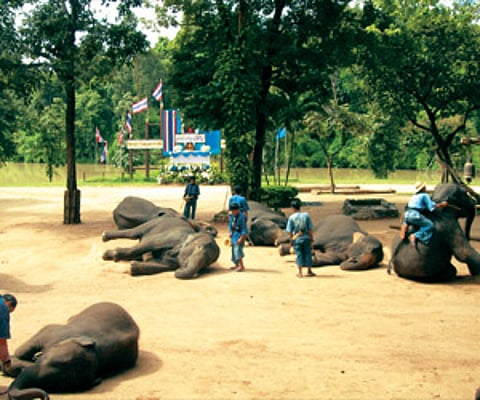
For those wanting to experience a bit of lush countryside beyond Chiang Mai, a visit to nearby elephant camps is a worthy option. I went to the one in Lampang, about 100 km from Chiang Mai. The centre has become extremely popular with tourists to see elephants playing. There are timed public shows, when you watch them bathing, saluting, pushing logs, standing on three legs and most surprisingly painting pictures that are sold to the visitors by auctioning.
You can touch and hug them, feed fruits and pose for a nice snap for the family album. It’s the only place in the world where baby elephants go to a school and there is even an elephant hospital. The serenity of the surroundings is appealing and elephant rides are available to explore the area.
The elephant school adds to an unique tourist experience in the already refreshing Northern Thailand.
— sandiphor@hotmail.com
Factfile
Getting there: Fly Thai Airways from Chennai to Chiang Mai via Bangkok. Accommodation: Stay at luxurious Shangri-La Hotel (www.shangri-la.com) in Chiang Mai. Local currency: Thai Bhat 1US$=34Bhat. Visa: Available at Bangkok airport. It can also be obtained from Thai Embassy New Delhi or Consulate office in Chennai. Log on to www.tourismthailand.org for more information.